India's southern state of Tamil Nadu has a long, peculiar political tradition: here, cinema doesn't merely entertain, it also governs.
From extremely successful political stints of MG Ramachandran - popularly known as MGR - and Jayalalithaa to the more ambivalent experiments of Rajnikanth, Kamal Haasan, Khushbu and Vijayakanth, the state has repeatedly seen cinema icons turn into full-time politicians. MGR and Jayalalithaa even became chief ministers.
Now Tamil superstar C Joseph Vijay, known as Thalapathy Vijay (General Vijay), is the latest to join the list.
He launched his political party, Tamilaga Vettri Kazhagam (TVK), in 2024 and soon after announced that he would retire from films to pursue politics full-time. His upcoming film this month, Jana Nayagan (The People's Hero), would be his farewell release, he said.
Vijay's reasoning was explicit: politics, he argued, is not something one can dabble in. Tamil Nadu's voters, he said, deserved nothing less than full commitment. And the state's political history supports that calculation.
MGR and Jayalalithaa withdrew from active stardom before consolidating power. But Kamal Haasan's hybrid approach, which involves being active in cinema and politics both, has yielded limited electoral results. Vijayakanth's party rose quickly but faltered organisationally. Tamil politics has little patience for half-measures.
It is against this unforgiving backdrop that Jana Nayagan arrives.
Steeped in political imagery and rhetoric, Vijay's new film will open in nearly 5,000 cinemas across India and overseas this month. At 51, the star is stepping away from a career most actors would be reluctant to leave. He remains among Indian cinema's most bankable stars, driving festival releases and revenues across the global Tamil diaspora - from satellite rights and music to merchandise.
Chennai-based film critic Aditya Shrikrishna noted that Vijay's appeal has not rested on acting prowess alone. He's not a Kamal Haasan or Rajinikanth in terms of filmography, he said. But his box office pull and fandom are huge and undeniably influential. Dancing, comedy and a keen understanding of populist cinema are his strengths.
Vijay's stardom, however, has never been accidental, said Pritham K Chakravarthy, film academic and critic. The seed was planted by his father who had Communist leanings and was keen on joining politics.
Vijay began as a child actor in the 1980s and was launched as a lead actor in 1992 by his parents. Over the next three decades, he appeared in nearly 70 films, charting a carefully calibrated rise - from playing the romantic hero in his films in the late 1990s to acting as an angry young man in the 2000s to a carefully-honed image as saviour and vigilante in films after 2012.
Though Vijay's early roles often leaned into hyper-masculine tropes, he later consciously course-corrected his image, points out Shrikrishna. He later started projecting a saviour figure rooted in social justice in his movies. He spoke of farmers' distress in Kaththi, healthcare corruption in Mersal, supporting women's sports in Bigil and electoral manipulation in Sarkar.
Long before Vijay launched his party, his cinema had thus already done the ideological groundwork. Audio launches doubled as soft political addresses. Fan clubs quietly transformed into grassroots networks.
The fandom is intense and ritualistic, with celebratory first-day screenings, milk offerings on towering cut-outs, garlands, drums, and whistles.
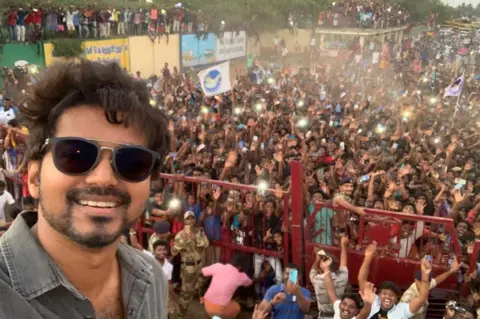
Vijay remains capable of turning a movie release into a mass civic event. He is perhaps the last of the mega stars of this scale, Shrikrishna said.
With CGI-enhanced action, thunderous fight sequences and dialogue like, I enter politics not to plunder, but to serve, the film blurs fiction and intent.
It echoes Vijay's rally speeches where he has attacked the ruling DMK, mocking Chief Minister MK Stalin as uncle, while also positioning himself firmly against Prime Minister Narendra Modi and his Bharatiya Janata Party (BJP).
Political analyst Sumanth C Raman said Vijay has a considerable following among Gen Z. However, a deadly crowd crush at a TVK rally raised sharp criticism of his party's organizational readiness and Vijay's leadership. Some analysts noted that the party lacked a credible second-tier leadership, unresolved alliance questions, and clear policies.
As the Tamil Nadu elections approach, Vijay's platform rests on broad themes - anti-corruption, social justice, Tamil pride, and resistance to what he calls authoritarianism by the federal government. Whether his cinema glamour translates into loyal votes remains to be seen, but the stakes are high as Tamil actors continue their notable transition into politics.