No serving leader in the European Union has led their country for as long as Viktor Orbán. But after 16 years he faces his strongest challenge yet in 12 April elections, where most opinion polls suggest he is heading for defeat at the hands of former party insider, Péter Magyar.
Since 2010, Orbán has transformed Hungary into what the European Parliament has denounced as a hybrid regime of electoral autocracy. He appears uncertain how to describe his own invention. He has tried both illiberal democracy, and Christian liberty. His allies in the US Mag movement call it national conservatism.
Orbán has repeatedly clashed with European Union colleagues on the war in Ukraine, blocking vital funding for Kyiv, which he accuses of trying to force Hungary into war with Russia.
And yet he has powerful international allies. He is considered Vladimir Putin's strongest partner in the EU, and he has been endorsed by US President Donald Trump in his bid for a fifth consecutive term in office. While Trump has promised to lead US economic might to Hungary if he wins again, Vice-President JD Vance visited Budapest five days before the election, intervening in the campaign to appeal to voters to stand with Viktor Orbán, because he stands for you.
Within the EU, the Fidesz leader's closest allies come from the radical and hard right. His antagonism towards Brussels still pays off with many Hungarians, but Orbán has cut an increasingly lonely figure among EU leaders looking for European unity in response to the war in Ukraine.
His Foreign Minister, Péter Szijjártó, recently admitted personally sharing details of EU meetings with his Russian counterpart Sergei Lavrov, but called those conversations everyday diplomacy.
Orbán and his foreign minister left Europe long ago, Poland's Prime Minister Donald Tusk observed.
His personal charisma has been an unquestionable ingredient of his success, but polls suggest many of his supporters have tired of him and the corruption allegations that have swirled around his party.
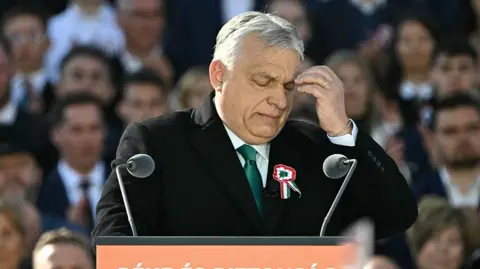
Orbán appeared rattled when he was booed during a March campaign speech in the north-western town of Győr. This was a very different Orbán from the man whose ex-football trainer once highlighted his ability to think on the ball. This was a leader who rolled up his sleeves and stacked sandbags alongside firemen and volunteers when toxic red sludge from a bauxite mine engulfed a Hungarian valley and threatened the Danube shore in 2010.
Now 62, Orbán first made his mark while still a law student in Budapest in the late 1980s as the Soviet Union began to fall apart, setting up a political movement called Fidesz, or Alliance of Young Democrats. If we believe in our own power, we are able to finish the communist dictatorship, he told an estimated quarter of a million Hungarians during an audacious seven-minute speech. They were gathered in the city's Heroes' Square for the reburial of the man behind Hungary's failed uprising in 1956, Imre Nagy.
Reflecting on his words 10 years later, he said he had exposed everyone's silent desire for free elections, and an independent and democratic Hungary. The democracy that replaced authoritarian Soviet rule has changed dramatically under Orbán, who according to Hungarian-born journalist Paul Lendvai has moved from one of the most promising defenders of Hungarian democracy into the chief author of its demise.
Prof Andras Bozoki, a former culture minister, describes Hungary since 2010 as being the only one former consolidated liberal democracy in the EU that has reached the level of a non-democratic system as a hybrid regime.
Viktor Orbán was born in 1963 an hour to the west of Budapest, the eldest of three sons whose father was an agricultural engineer and Communist Party member and whose mother was a special needs teacher. They had no running water at the family home in Felcsut, a village of about 2,000 people where he still owns a house. In an 1989 interview, he recalled being beaten twice a year by his father, Gyozo, whom he described as a violent man: When he beat me, he also shouted. I remember all this as a bad experience.
Nothing about his childhood suggested that he would go on to challenge the communist regime. He attended a grammar school and was involved in the Young Communist League.
His main interest was football, playing for his local club, FC Felcsut, and he remains highly enthusiastic about his childhood sport. In 2014 he inaugurated a controversial new stadium there called the Pancho Arena, where top-flight team Puskás Akadémia plays to small crowds.
Going into the 12 April vote, Ukraine has become Orbán's main campaign focus, as he accuses Volodymyr Zelensky of blocking Hungary's oil supply and his opponents of wanting to hand Hungarian money to Kyiv. Although he has been able to rely on Trump and Putin for political support, his claim to be protecting Hungary from leaders who wage war has become increasingly shaky. He has not experienced electoral defeat since 2006. Despite the support of both Vladimir Putin and Donald Trump, he is now facing the biggest test of his political career.