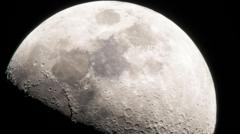
NASA’s latest unveiling paints a dramatic picture of America’s future in space: a semi‑permanent lunar base nestled at the South Pole’s ice‑rich craters, powered by a fission reactor and solar panels, and staffed by astronauts from 2032 onward.
The agency’s “Ignition Moon Base” programme is divided into three phases. In the first, 25 robotic missions—including landers from Blue Origin, Astrobotic, and Intuitive Machines—will be dispatched from 2024 to 2029, carrying high‑resolution cameras, laser‐range finders, and other payloads to map the rugged terrain and assess water‑ice deposits. The second phase sees the construction of nuclear and solar infrastructure that will keep a human crew alive and productive, while the third lays out a roadmap for a semi‑permanent habitat and rovers capable of long‑range traverses.
Blue Origin’s payload‑lift ‘Endurance’ will perform precision landings at the South Pole, the agency’s chief Jared Isaacman said on Tuesday, “These vehicles are the stepping stone to eventual human transit. In 25 launches, we will have 4 metric tonnes of cargo on the Moon.”.
The biggest race, however, is political. President‑elect Donald Trump’s 2029 lunar‑landing deadline—set to return when he leaves office—casts a hard timeline on the mission. NASA said it “will never give up the Moon again,” pointing to the competitive pressure from China, which is expected to land humans on the lunar surface by 2030.
Contrary to NASA’s optimistic schedule, many experts caution that execution is far from assured. Dr. Simeon Barber, Lunar Scientist at the Open University, told the BBC that “the Starship Human Landing System is still a work in progress, and we’re not sure it’s ready before 2029.” A spokesman for SpaceX emphasized that “the limiting step is getting the astronauts down onto the surface,” highlighting the challenges at the hard bottom of the lunar descent.
Despite the hurdles, NASA’s artist’s renderings of the lunar base—showing compact habitats, a nuclear reactor, and rover teams—garnerled widespread support. If NASA can shepherd the multi‑agency consortium through the year‑by‑year milestones on schedule, the United States could join the growing list of nations with a foothold on the Moon, providing a secure launch pad for future missions to Mars.
As the agency reiterated its commitment to the Artemis program, the next steps are clear: finish the autonomous lander tests by 2025, launch the Starship HLS by 2027, and have the first human crew on Magallanes‐Crater by 2032.
The next decade will decide whether the United States, China, or a coalition of private companies can rewrite humanity’s celestial itinerary. For now, NASA’s plans chart a bold yet uncertain course to the Moon’s silent, icy south pole.
The agency’s “Ignition Moon Base” programme is divided into three phases. In the first, 25 robotic missions—including landers from Blue Origin, Astrobotic, and Intuitive Machines—will be dispatched from 2024 to 2029, carrying high‑resolution cameras, laser‐range finders, and other payloads to map the rugged terrain and assess water‑ice deposits. The second phase sees the construction of nuclear and solar infrastructure that will keep a human crew alive and productive, while the third lays out a roadmap for a semi‑permanent habitat and rovers capable of long‑range traverses.
Blue Origin’s payload‑lift ‘Endurance’ will perform precision landings at the South Pole, the agency’s chief Jared Isaacman said on Tuesday, “These vehicles are the stepping stone to eventual human transit. In 25 launches, we will have 4 metric tonnes of cargo on the Moon.”.
The biggest race, however, is political. President‑elect Donald Trump’s 2029 lunar‑landing deadline—set to return when he leaves office—casts a hard timeline on the mission. NASA said it “will never give up the Moon again,” pointing to the competitive pressure from China, which is expected to land humans on the lunar surface by 2030.
Contrary to NASA’s optimistic schedule, many experts caution that execution is far from assured. Dr. Simeon Barber, Lunar Scientist at the Open University, told the BBC that “the Starship Human Landing System is still a work in progress, and we’re not sure it’s ready before 2029.” A spokesman for SpaceX emphasized that “the limiting step is getting the astronauts down onto the surface,” highlighting the challenges at the hard bottom of the lunar descent.
Despite the hurdles, NASA’s artist’s renderings of the lunar base—showing compact habitats, a nuclear reactor, and rover teams—garnerled widespread support. If NASA can shepherd the multi‑agency consortium through the year‑by‑year milestones on schedule, the United States could join the growing list of nations with a foothold on the Moon, providing a secure launch pad for future missions to Mars.
As the agency reiterated its commitment to the Artemis program, the next steps are clear: finish the autonomous lander tests by 2025, launch the Starship HLS by 2027, and have the first human crew on Magallanes‐Crater by 2032.
The next decade will decide whether the United States, China, or a coalition of private companies can rewrite humanity’s celestial itinerary. For now, NASA’s plans chart a bold yet uncertain course to the Moon’s silent, icy south pole.