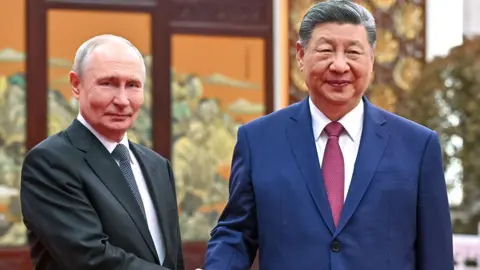
The red carpet, the military band, and the nostalgic strains of 'Moscow Nights' created a cinematic scene in Beijing as Vladimir Putin and Xi Jinping embraced the symbolism of their relationship. 'My dear friend,' Putin said with a smile. 'My old friend,' Xi replied—words that echoed their over 40 summits and public rhetoric of 'strategic co-operation' and 'mutual trust.' The Kremlin had even strategically juxtaposed this encounter with Trump's departure from China, projecting Russia and China as 'shoulder-to-shoulder' powerhouses. Yet beneath the tea ceremony and romantic melodies lay a geopolitical truth: this partnership, while deep, is not boundless.
Russia's ambition to export Russian natural gas via the Power of Siberia 2 pipeline stalled dramatically. Despite a 2023 memorandum of understanding, Beijing's delay stems from dual concerns—pricing disputes and fears of over-reliance on Russian fossil fuels. As one Russian official acknowledged, 'The positions of Russia and China are not identical. Their interests do not always coincide.' The Kremlin's admission of this friction came alongside images of Putin and Xi walking side-by-side, creating a stark contrast between symbolic unity and economic pragmatism.
This visit echoes a previous failed diplomatic gamble: the illusory 'spirit of Anchorage' between Putin and Trump that never materialized. Putin's foreign policy aide Yuri Ushakov bluntly confirmed its absence: 'The spirit of Anchorage? I never used that phrase.' Meanwhile, the Russia-China relationship thrives on a different calculus. While Beijing offers warmth and political solidarity, it demands economic leverage—exactly what Moscow lacks in its pipeline negotiations.
The summit underscores a critical shift in global power dynamics. As China navigates the complexities of energy dependence and pricing power, Russia faces a dilemma: maintain its China partnership while seeking alternative markets. With Europe's markets shrinking and the U.S. offering only limited alternatives, Putin may be forced to reconsider energy export strategies. But as he departed Beijing, one question remains clear: can a relationship built on mutual interest survive when interests diverge?}
Russia's ambition to export Russian natural gas via the Power of Siberia 2 pipeline stalled dramatically. Despite a 2023 memorandum of understanding, Beijing's delay stems from dual concerns—pricing disputes and fears of over-reliance on Russian fossil fuels. As one Russian official acknowledged, 'The positions of Russia and China are not identical. Their interests do not always coincide.' The Kremlin's admission of this friction came alongside images of Putin and Xi walking side-by-side, creating a stark contrast between symbolic unity and economic pragmatism.
This visit echoes a previous failed diplomatic gamble: the illusory 'spirit of Anchorage' between Putin and Trump that never materialized. Putin's foreign policy aide Yuri Ushakov bluntly confirmed its absence: 'The spirit of Anchorage? I never used that phrase.' Meanwhile, the Russia-China relationship thrives on a different calculus. While Beijing offers warmth and political solidarity, it demands economic leverage—exactly what Moscow lacks in its pipeline negotiations.
The summit underscores a critical shift in global power dynamics. As China navigates the complexities of energy dependence and pricing power, Russia faces a dilemma: maintain its China partnership while seeking alternative markets. With Europe's markets shrinking and the U.S. offering only limited alternatives, Putin may be forced to reconsider energy export strategies. But as he departed Beijing, one question remains clear: can a relationship built on mutual interest survive when interests diverge?}