BYD's Resilience: Thriving Amidst US Market Absence
The recent surge in fuel prices spurred by geopolitical tensions has generated increased global interest in electric vehicles (EVs), showcasing the strengths of Chinese manufacturers like BYD.
Despite being largely excluded from the US car market, China remains the world’s leading electric vehicle producer, with demands shifting towards Asia and other regions such as Brazil and the UK.
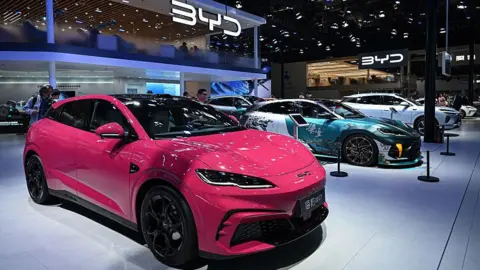
BYD's impressive global sales saw it outpace Tesla last year, positioning itself as a prominent player in the EV market.
Stella Li, BYD’s executive vice president, revealed the company’s current strategy involves meeting escalating demand in non-US markets while emphasizing that they can achieve continued success without US consumers.
Li remarked, We are experiencing higher demand than our supply can currently meet, highlighting BYD's need to focus on expansion beyond US borders.
In a bid to tackle the common concern over charging time faced by EV users, BYD is introducing their innovative ‘flash charging’ technology, which can reportedly add hundreds of kilometers of range in mere minutes.
This pivotal development aims to make EVs more attractive and accessible, potentially increasing BYD's market competitiveness.
The Beijing Auto Show, now the largest event in the automotive industry globally, displayed over 1,400 vehicles, positioning Chinese car makers, particularly BYD, in the spotlight.
Despite facing increasing tariffs and scrutiny in global markets, BYD is gaining significant brand recognition and expanding its presence, especially in Europe.
Li's comments on BYD's diversification beyond cars, as they manufacture components for smartphones and other eco-friendly energy sources, emphasize the company as a holistic ecosystem in the tech landscape.
Innovations from the Auto Show
At the Auto Show, companies like X-Peng are also pushing boundaries with the introduction of innovative products, from new electric SUVs to planned humanoid robots and even flying cars.
Foreign competitors are increasingly collaborating with local firms to adapt to the rapid evolution of the industry, as illustrated by several partnerships between Chinese EV manufacturers and international car brands.
Although the market for electric vehicles is expanding, intense competition in China is raising challenges for established players like BYD, especially in maintaining profitability amid pricing wars.
While BYD's domestic sales have witnessed a decline in recent months, their sales in Europe have surged, indicating a significant shift in consumer preferences and market dynamics.
As the market matures, Li anticipates that consolidation among EV manufacturers will become a reality, as not all firms will endure amidst such fierce competition.
This scenario echoes historical patterns from prior technological evolutions where market leaders eventually emerged from intense competition.
BYD's ability to navigate complex market challenges while leveraging technological advancements and responding to consumer demands positions it favorably for future growth.