BYD Thrives in Global EV Market without U.S. Presence
The recent surge in fuel prices due to war dynamics has spurred demand for electric vehicles (EVs) globally. Chinese manufacturers are seizing this opportunity, with BYD taking center stage.
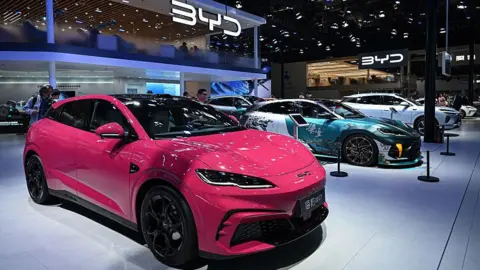
China, the world's largest producer of EVs, is witnessing a growing interest in its automotive offerings despite being largely excluded from the U.S. market. BYD, leading the charge, has surpassed Tesla as the biggest EV seller and is rapidly expanding its international footprint.
Stella Li, BYD's executive vice president, noted, We survive and are successful without the US market today, during an interview at the Beijing Auto Show. The company is focusing on meeting increasing demand in countries like Brazil and across Europe instead of vying for U.S. consumers.
In light of rising oil prices, consumers are increasingly turning to EVs for their cost-saving capabilities. Consumers feel the daily savings when oil prices increase. EVs help them save money every day, Li emphasized, highlighting the demand surge.
However, BYD faces challenges, stating, Actually, we are now suffering [from] insufficient capacity. Our demand is much higher than what we can supply. To address this, BYD is banking on its new flash charging technology, which could eliminate key barriers to EV adoption by drastically reducing charging times.
With aspirations to deliver hundreds of kilometers of range within minutes, this tech development may persuade skeptical customers to consider switching to electric vehicles.
This year's Beijing Auto Show saw over 1,400 vehicles showcased, underscoring the prominence of Chinese carmakers. As BYD charts a path against a complex global backdrop, challenges such as tariffs and regulatory scrutiny from the U.S. loom over Chinese EV-makers. Nonetheless, BYD is gaining brand recognition in markets like the UK.
By innovating in technology, including battery development and software systems, Chinese manufacturers are moving away from merely competing on price. According to Li, We are not just a car company; we are an ecosystem, indicating BYD's engagement in various sectors beyond automobiles.
Global Competition and Innovation
The Auto Show also featured futuristic concepts, with companies like X-Peng preparing to introduce humanoid robots and flying cars by 2027, pushing the boundaries of automotive technology.
As traditional automakers such as Volkswagen and Toyota navigate operational challenges in China, many are opting for collaborations with local firms to remain relevant. The competitive landscape is fierce, with price wars intensifying among domestic manufacturers.
Even experienced companies like BYD are grappling with declining domestic sales, contrasting sharply with their successes in international markets, particularly with significant growth seen in Europe. Li acknowledges the inevitable consolidation that will arise from ongoing competition, echoing patterns observed in automotive cycles.