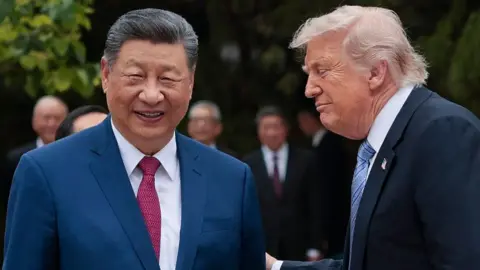
US President Donald Trump left Beijing after a two-day summit saying he had struck 'fantastic trade deals, great for both countries', but few details have emerged on what the two superpowers agreed.
Trump arrived for a high-stakes summit with Chinese leader Xi Jinping on Wednesday, accompanied by several CEOs: a high-profile business delegation spanning agriculture, aviation, electric vehicles, and artificial intelligence (AI) chips.
Trade was near the top of the agenda despite recent tensions over the Iran war, and businesses hoped for key deals as well as an extension of the tariff truce that is due to expire in November.
The visit was defined by warm rhetoric and symbolism. Trump was wooed with a packed itinerary that included an honour guard, a state banquet, and an invitation to the exclusive compound where China's Communist Party leaders live and work.
The US president seemed impressed and invited Xi to the White House in September. He described the talks as 'very successful', while Xi labeled it a 'historic and landmark' visit.
However, there was a lack of announced trade breakthroughs or significant business deals. President Trump, in conversations aboard Air Force One, claimed China had agreed to buy 200 Boeing jets, with a potential commitment to purchase an additional 750 planes, a statement which Boeing confirmed.
Trump also stated that American farmers would benefit from China buying 'billions of dollars' of soybeans. Yet, no confirmations of such deals from China were made. Should the Boeing order materialize, it would mark a significant return to the Chinese market for the aircraft manufacturer after a prolonged trade battle.
With the agreement of buying 200 jets, the potential deals aim to revive trade ties amid ongoing tariffs and restrictions. If finalized, these deals could reshape the financial landscape for American agriculture and aerospace in China.
Despite the optimistic echoes from both sides, significant differences remain, particularly in addressing the broader economic relationship, including tariffs, access to technology, and geopolitical tensions surrounding Taiwan.
As preparations proceed for a second meeting this autumn, it remains uncertain whether meaningful resolutions will emerge from ongoing discussions amidst a backdrop of complex international relations.