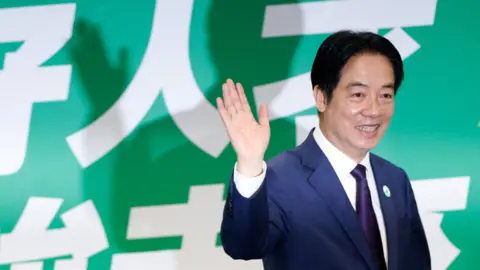
Taiwan has insisted it is a sovereign, independent nation, after US President Donald Trump cautioned it against formally declaring independence from China.
Trump's remarks came after a two-day summit in Beijing, after which he said he had made no commitment either way about the self-governing island - which China claims as part of its territory and has not ruled out taking by force.
After talks with Chinese President Xi Jinping, Trump also said he would soon decide whether to approve an $11bn ($8bn) package of weapons to be sold to Taiwan.
The US administration is bound by law to provide Taiwan with a means of self-defence, but has frequently had to square this alliance with maintaining a diplomatic relationship with China.
Taiwanese President Lai Ching-te has previously stated that Taiwan does not need to declare formal independence because it already sees itself as a sovereign nation.
On Saturday, presidential spokesperson Karen Kuo said it was self-evident that Taiwan was a sovereign, independent democratic country. She added, however, that Taiwan was committed to maintaining the status quo with China - in which Taiwan neither declares independence from China nor unites with it.
Many Taiwanese consider themselves to be part of a separate nation, though most are in favour of maintaining their current status.
Washington's established position is that it does not support Taiwanese independence, with continued ties with Beijing being contingent on its acceptance that there is only one Chinese government.
In an interview with Fox News after meetings with President Xi, Trump reiterated that US policy on Taiwan had not changed, while making it clear he did not seek conflict with Beijing.
On the flight back to Washington, the US president had told reporters that he and Xi had spoken a lot about the island, but said he had declined to discuss whether the US would defend it.
Xi feels very strongly about the island and doesn't want to see a movement for independence, Trump said.
Chinese President Xi Jinping has previously described Taiwan's president as a troublemaker and a destroyer of cross-strait peace.
China has ramped up military drills around the island in recent years, raising tensions in the region and testing the balance that Washington has struck.
Trump said the impending arms package would be discussed with Taiwan's leadership and added: I'm going to say I have to speak to the person that right now is, you know, you know who he is, that's running Taiwan.
The US does not have formal relations with Taiwan, though it maintains substantial unofficial relations. US presidents do not traditionally speak directly to Taiwan's leader, and to do so would be likely to cause significant tensions with Beijing.
Our nation is grateful to President Trump for his continued support for security in the Taiwan Strait since his first term in office, Taiwan's presidential spokesman said.
Taiwan will continue to deepen cooperation with the US to achieve peace through strength, ensuring that peace and stability across the Taiwan Strait are not threatened or undermined, which serves the common interests of Taiwan, the US, and the global democratic community.