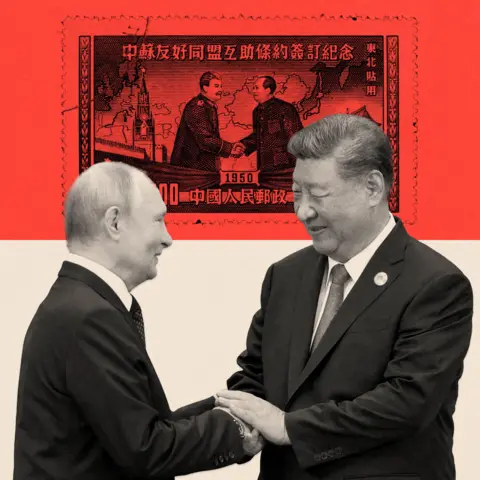
As they strolled through Tiananmen Square in Beijing last September, Chinese President Xi Jinping and Russian President Vladimir Putin appeared to muse over the possibility that organ transplants could dramatically extend human life. Human organs can be continuously transplanted. The longer you live, the younger you become, and even achieve immortality, Putin's interpreter was heard saying. Some predict that in this century, humans may live up to 150 years old, Xi's interpreter responded.
This was a rare insight into a misunderstood partnership between two strongmen, who have described each other as best friends, and who, after a combined 39 years in power, show no signs of stepping down. The conversation reflects the humanity amidst the political dynamics at play.
Putin’s upcoming visit to Beijing, coinciding with the 25th anniversary of the Treaty of Good-Neighbourliness and Friendly Cooperation, highlights the depth of Sino-Russian relations, particularly in the economic sphere. China stands as Russia's largest trading partner, while Russia accounts for a mere 4% of China's trade.
Sanctions imposed on Russia have pushed it further into China's embrace, with tech firms such as Huawei filling the void left by western companies, particularly in telecommunications.
Despite asymmetries in power — highlighted by comments from analysts that indicate that Russia operates largely within China’s sphere — both nations benefit from a strategic partnership that eschews formal alliances in favor of a flexible approach. This flexibility allows for cooperation without the rigidity that often defines military alliances.
The question of whether their relationship is a stable friendship or a mere tactical alliance continues to be a topic of intense discussion, especially as both sides navigate external pressures and shifting global dynamics. Analysts argue that while divisions exist, both countries share crucial resources and ideologies that foster an enduring partnership.
Furthermore, amid increasing economic interdependence and shared geopolitical interests, the relationship is increasingly scrutinized for its long-term implications on global power dynamics. Whether the two can truly remain partners without one dominating the other is an ongoing issue, with insights revealing that China’s growing economic clout could shape future interactions.
Ultimately, the partnership remains resilient, recognizing the lack of viable alternatives and the mutual benefits that arise from their collaborative efforts in navigating a world they perceive as divided by Western influence.
This was a rare insight into a misunderstood partnership between two strongmen, who have described each other as best friends, and who, after a combined 39 years in power, show no signs of stepping down. The conversation reflects the humanity amidst the political dynamics at play.
Putin’s upcoming visit to Beijing, coinciding with the 25th anniversary of the Treaty of Good-Neighbourliness and Friendly Cooperation, highlights the depth of Sino-Russian relations, particularly in the economic sphere. China stands as Russia's largest trading partner, while Russia accounts for a mere 4% of China's trade.
Sanctions imposed on Russia have pushed it further into China's embrace, with tech firms such as Huawei filling the void left by western companies, particularly in telecommunications.
Despite asymmetries in power — highlighted by comments from analysts that indicate that Russia operates largely within China’s sphere — both nations benefit from a strategic partnership that eschews formal alliances in favor of a flexible approach. This flexibility allows for cooperation without the rigidity that often defines military alliances.
The question of whether their relationship is a stable friendship or a mere tactical alliance continues to be a topic of intense discussion, especially as both sides navigate external pressures and shifting global dynamics. Analysts argue that while divisions exist, both countries share crucial resources and ideologies that foster an enduring partnership.
Furthermore, amid increasing economic interdependence and shared geopolitical interests, the relationship is increasingly scrutinized for its long-term implications on global power dynamics. Whether the two can truly remain partners without one dominating the other is an ongoing issue, with insights revealing that China’s growing economic clout could shape future interactions.
Ultimately, the partnership remains resilient, recognizing the lack of viable alternatives and the mutual benefits that arise from their collaborative efforts in navigating a world they perceive as divided by Western influence.