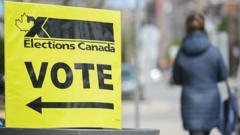
As April 28 approaches, Canadians are gearing up to make critical decisions about their government amid an ongoing trade dispute with the United States, particularly in light of President Trump's remarks regarding Canada. With a quarter of eligible voters having already participated, mail-in voting has seen a notable rise, totaling over 754,000 ballots returned, compared to 660,000 in the previous election cycle.
Current polling indicates that the ruling Liberal party, led by Mark Carney, is maintaining a slight edge of five points over the Conservative party led by Pierre Poilievre. Carney, positioned as a competent leader in navigating trade tensions with the U.S., has emphasized his party's capability to handle such issues, while Poilievre focuses on change resonating with voters concerned about living costs and government spending.
The political landscape is further complicated by the presence of the Bloc Quebecois and the New Democratic Party, which are navigating their own challenges in the lead-up to the election. As the final campaigns unfold, Canadians are poised to make pivotal choices about their nation’s future governance.
Current polling indicates that the ruling Liberal party, led by Mark Carney, is maintaining a slight edge of five points over the Conservative party led by Pierre Poilievre. Carney, positioned as a competent leader in navigating trade tensions with the U.S., has emphasized his party's capability to handle such issues, while Poilievre focuses on change resonating with voters concerned about living costs and government spending.
The political landscape is further complicated by the presence of the Bloc Quebecois and the New Democratic Party, which are navigating their own challenges in the lead-up to the election. As the final campaigns unfold, Canadians are poised to make pivotal choices about their nation’s future governance.