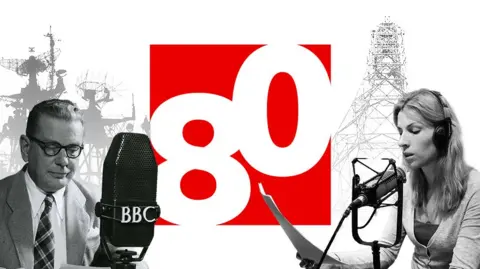
The Kremlin is tightening its grip over what Russians can do and see online, making it harder for outlets like the BBC to reach their audiences. For the past 80 years, BBC Russian has sought to bypass those restrictions, which for decades featured jamming of its short-wave radio broadcasts and now involve blocking its website. The latest restrictions in Russia have included widespread mobile internet outages and a reported plan to block the Telegram news and messaging app. On 24 March 1946, the BBC started its first regular radio broadcast in the Russian language aiming at giving listeners behind the Iron Curtain in the Soviet Union an alternative to state propaganda and a tightly controlled cultural scene.
By 1949, jamming of the signal was already the norm. For almost half the 20th Century, Soviet people had to jump through hoops to listen to foreign broadcasts, and for some it was truly a sport, remembers Natalia Rubinstein, an ex-BBC presenter and former resident of Leningrad, or modern-day St Petersburg. We really wanted to know what was being hidden from us, she says. Rubinstein recalls how people who were fond of cross-country skiing – a very popular pastime in winter in Russia – used to take their radios with them out of the town, where there were fewer jammers.
Several tactics were employed to bypass jamming, as it became essential for Soviet citizens to hear the 'enemy voices' of the BBC broadcasts. During the Cold War, the BBC would repeat its 90-minute Russian-language bulletin three times a week, so people could listen at least once. It was not just news; Soviets could tune in to Western rock music, hear extracts from banned literature, and even, for a brief time, participate in quizzes.
The dynamic changed significantly post-1989 with the fall of the Iron Curtain. BBC Russian moved into its first office in Moscow, and by 2022, it had grown to more than 100 journalists, adapting to an increasingly digital and social media-driven environment.
However, the service faces renewed challenges amidst Russia's invasion of Ukraine. As of March 2022, BBC Russian's website was among those blocked by the government, accused of disseminating false information. Despite that, the audience for BBC Russian has more than tripled, now reaching up to 12 million people each week.
As censorship has intensified, BBC Russian has had to relocate its operations, with many journalists declaring 'foreign agents' facing legal repercussions. Yet, as head of BBC News Russian, Jenny Norton, states, A new generation of Russians are now having to fight to stay connected to the world, underscoring the ongoing importance of BBC Russian's commitment to providing unfiltered news.
By 1949, jamming of the signal was already the norm. For almost half the 20th Century, Soviet people had to jump through hoops to listen to foreign broadcasts, and for some it was truly a sport, remembers Natalia Rubinstein, an ex-BBC presenter and former resident of Leningrad, or modern-day St Petersburg. We really wanted to know what was being hidden from us, she says. Rubinstein recalls how people who were fond of cross-country skiing – a very popular pastime in winter in Russia – used to take their radios with them out of the town, where there were fewer jammers.
Several tactics were employed to bypass jamming, as it became essential for Soviet citizens to hear the 'enemy voices' of the BBC broadcasts. During the Cold War, the BBC would repeat its 90-minute Russian-language bulletin three times a week, so people could listen at least once. It was not just news; Soviets could tune in to Western rock music, hear extracts from banned literature, and even, for a brief time, participate in quizzes.
The dynamic changed significantly post-1989 with the fall of the Iron Curtain. BBC Russian moved into its first office in Moscow, and by 2022, it had grown to more than 100 journalists, adapting to an increasingly digital and social media-driven environment.
However, the service faces renewed challenges amidst Russia's invasion of Ukraine. As of March 2022, BBC Russian's website was among those blocked by the government, accused of disseminating false information. Despite that, the audience for BBC Russian has more than tripled, now reaching up to 12 million people each week.
As censorship has intensified, BBC Russian has had to relocate its operations, with many journalists declaring 'foreign agents' facing legal repercussions. Yet, as head of BBC News Russian, Jenny Norton, states, A new generation of Russians are now having to fight to stay connected to the world, underscoring the ongoing importance of BBC Russian's commitment to providing unfiltered news.