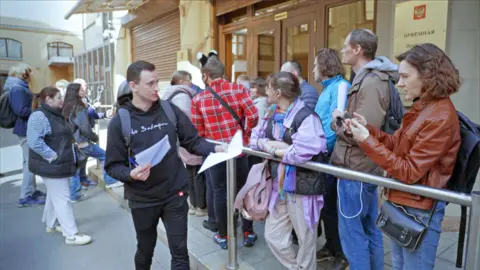
Near the Kremlin, several dozen people recently queued outside the presidential administration office to submit petitions calling on President Vladimir Putin to end a crackdown on the internet. Russian authorities have been tightening control of the country's cyberspace, restricting access to global messaging apps and subjecting citizens to widespread disruptions, even shutdowns, of mobile internet. Despite it being legal to petition the president, doing so in an authoritarian state poses significant risks. Security officers have been spotted filming the petitioners, creating an atmosphere of fear and tension.
Activist Yulia Grekova voiced her concerns about the internet restrictions, highlighting the direct impact on her catering business, which relies heavily on online accessibility for generating revenue. 'Without internet access, our business will not exist,' she expressed.
Putin has acknowledged the disruptions, claiming they are necessary for operational work related to preventing terrorist attacks, yet discontent is growing among the population as they find it difficult to manage their everyday lives without reliable internet access.
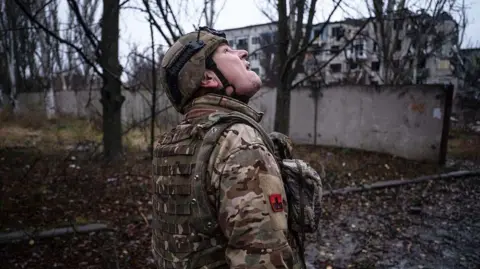
Officials justify the curbs on communication as necessary for public safety, alleging that mobile internet blackouts confuse Ukrainian attack drones, but observers argue this has not effectively prevented attacks.
With internet censorship appearing to deepen, there are public concerns about a new ‘digital Iron Curtain’ separating Russia from the outside world. The Kremlin promotes a state-backed messenger named MAX, but many people are wary of its surveillance implications.
As Russians navigate these challenges, the impact on daily life becomes increasingly evident, with individuals struggling to communicate and conduct business. Public sentiment is shifting, with many starting to see a connection between their everyday difficulties and the political regime's actions.
In the midst of uncertainty, individuals like Grekova express hopes for change but recognize the ongoing repression: 'The future is not even mentioned in day-to-day conversations with friends and relatives.' A growing sense of public discontent may lead to significant ramifications in the future.
Activist Yulia Grekova voiced her concerns about the internet restrictions, highlighting the direct impact on her catering business, which relies heavily on online accessibility for generating revenue. 'Without internet access, our business will not exist,' she expressed.
Putin has acknowledged the disruptions, claiming they are necessary for operational work related to preventing terrorist attacks, yet discontent is growing among the population as they find it difficult to manage their everyday lives without reliable internet access.
Officials justify the curbs on communication as necessary for public safety, alleging that mobile internet blackouts confuse Ukrainian attack drones, but observers argue this has not effectively prevented attacks.
With internet censorship appearing to deepen, there are public concerns about a new ‘digital Iron Curtain’ separating Russia from the outside world. The Kremlin promotes a state-backed messenger named MAX, but many people are wary of its surveillance implications.
As Russians navigate these challenges, the impact on daily life becomes increasingly evident, with individuals struggling to communicate and conduct business. Public sentiment is shifting, with many starting to see a connection between their everyday difficulties and the political regime's actions.
In the midst of uncertainty, individuals like Grekova express hopes for change but recognize the ongoing repression: 'The future is not even mentioned in day-to-day conversations with friends and relatives.' A growing sense of public discontent may lead to significant ramifications in the future.