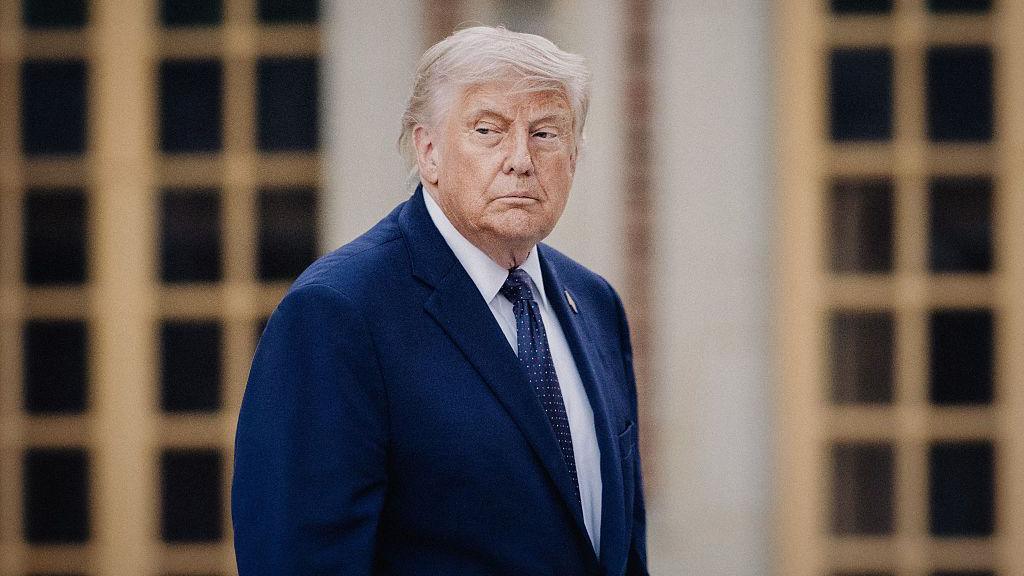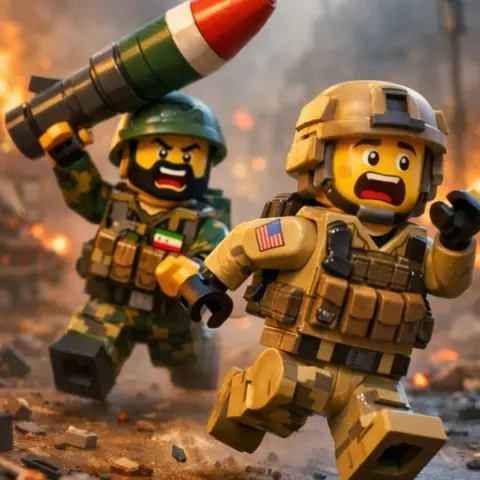
At first glance, they look like scenes out of a Lego movie, although more vivid and fast-paced. But these viral AI videos inspired by the instantly recognisable Lego aesthetic feature dying children, fighter jets, and US President Donald Trump – and are in fact pro-Iran propaganda.
For our new BBC podcast, Top Comment, we spoke to a representative of Explosive Media, one of the key accounts generating these clips. He wanted us to refer to him as Mr Explosive.
He's a savvy social media operator who initially denies working for the Iranian government. In previous interviews, the outlet has said it is totally independent. But upon further questioning, Mr Explosive admits the regime is a customer – something he's never before confirmed publicly.
The overriding message of these videos is that Iran is resisting what it sees as an almighty global oppressor: the United States. The clips are garish and not subtle at all – but that hasn't put a dent in how vigorously people are sharing and commenting on them.
In one of the videos, Donald Trump falls through a whirlwind of Epstein file documents as rap lyrics tell us the secrets are leaking, the pressure is rising. In another, George Floyd can be seen under a policeman's boot as we hear Iran is standing here for everyone your system ever wronged.
Slopaganda – coined in an academic paper last year as a play on 'AI slop' – is too weak a term to capture how powerful this highly sophisticated content is, says leading propaganda expert Dr. Emma Briant. AI-generated propaganda clips are estimated to have been viewed hundreds of millions of times over the course of the war.
In our video call with Mr Explosive, he appears silhouetted and flanked by red and green light, the colours of the Iranian flag. He says his team at Explosive Media consists of fewer than ten people who use Lego-style graphics because it is a world language. Iranian and Russian state media accounts on X regularly share them to millions of followers.
Mr Explosive defends his team's relationship with the government saying it was honourable to work for the homeland. He dismisses the recent mass protests as a coup funded by President Trump. Most Iranians are unable to use the internet due to a nationwide internet shutdown, but Mr Explosive claims he could contact the BBC using journalist internet granted by the Iranian government.
The videos are also littered with factual inaccuracies. In one clip, the Iranian military is shown capturing a downed US fighter-jet pilot, a claim disputed by US officials who confirmed the pilot was rescued. Mr Explosive does not accept this and claims: Possibly there was no lost pilot, there was no rescue operation. Their main goal was to steal uranium from Iran.
AI has enabled Iran and others to communicate directly with Western audiences more effectively than ever before, Briant says. This is what authoritarian countries wanting to target the West have lacked in the past. According to Dr. Tine Munk, a cyber warfare expert at Nottingham Trent University, Iran's tactics represent defensive memetic warfare to combat US rhetoric.
Social media platforms have been shutting down accounts with the Lego-style videos, but new ones seem to pop up just as quickly. It's a form of agile, aggressive internet diplomacy that appears to be here to stay.
Ultimately, these developments call into question the effectiveness of traditional diplomacy as they redefine how nations engage in information warfare, raising risks of misinterpretation and escalation.