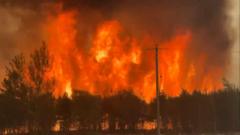
Military aircraft and helicopters are actively engaged in rescuing residents from the rapidly advancing wildfires in Manitoba, Canada. Thousands have already fled various parts of western Canada, particularly in the central prairie provinces of Saskatchewan and Manitoba, as firefighters contend with escalating flames fueled by exceptionally hot and dry weather forecasts. Reports indicate there are over 180 wildfires currently raging across the country, with smoke drifting across Canada and into parts of the United States.
Saskatchewan and Manitoba have both declared states of emergency, seeking international assistance to combat the blazes. Aerial footage has captured significant smoke plumes as the wildfires wreak havoc across the landscape. In Manitoba, the situation is particularly critical in the northern First Nations community of Pukatawagan, where officials have labeled the response as a “rapidly evolving situation.” The Canadian Armed Forces, alongside the Manitoba Wildfire Service and Heavy Urban Search and Rescue Team, are utilizing military resources to safely evacuate residents from the endangered area. Despite the ongoing effort, more than 2,000 individuals remain in need of transport from Pukatawagan.
Flin Flon, a city in Manitoba with a population of 5,000, is now largely deserted, with only first responders and essential personnel remaining. The province’s fire situation report indicates a total of 25 active fires, with 10 classified as out of control. While Manitoba faces the most significant challenges, neighboring Saskatchewan is also grappling with intensified wildfire outbreaks; as of Saturday, 16 wildfires are reported, with seven not contained. According to the Canadian Interagency Forest Fire Centre (CIFFC), Saskatchewan’s wildfire conditions are deemed extreme.
Meteorologist Danielle Desjardins from Environment and Climate Change Canada cautioned that while a cold front may impact certain areas, it will not alleviate the ongoing dangers. The forecast predicts windier conditions that, combined with heat and insufficient rainfall, are likely to exacerbate wildfire spread. Furthermore, smoke from the fires has resulted in air quality warnings for an estimated 22 million Americans, especially in Michigan, Wisconsin, and northern Minnesota, where conditions are labeled “unhealthy for everyone.”
Canada is currently experiencing one of its worst wildfire seasons on record, with over 42 million acres (17.3 million hectares) scorched this year. Although wildfires occur naturally in many regions globally, experts warn that climate change is increasing the likelihood of the conditions that allow them to thrive. The ongoing severe and prolonged heat continues to sap moisture from the soil and vegetation, creating a hazardous environment.