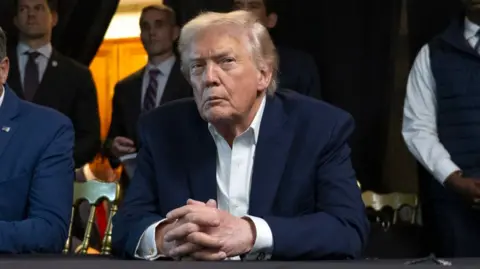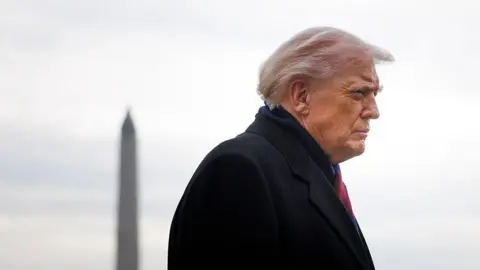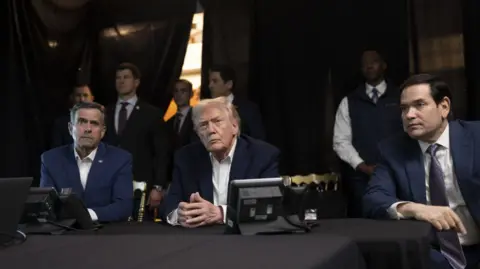
NEW YORK (AP) — Reviving a campaign pledge, President Donald Trump wants a one-year, 10% cap on credit card interest rates, a move that could save Americans tens of billions of dollars but drew immediate opposition from an industry that has been in his corner.
Trump was not clear in his social media post Friday night whether a cap might take effect through executive action or legislation, though one Republican senator said he had spoken with the president and would work on a bill with his “full support.” Trump said he hoped it would be in place Jan. 20, one year after he took office.
Strong opposition is certain from Wall Street and the credit card companies, which donated heavily to his 2024 campaign and to support his second-term agenda.
“We will no longer let the American Public be ripped off by Credit Card Companies that are charging Interest Rates of 20 to 30%,” Trump wrote on his Truth Social platform.
Researchers who studied Trump’s campaign pledge after it was first announced found that Americans would save roughly $100 billion in interest a year if credit card rates were capped at 10%. The same researchers found that while the credit card industry would take a major hit, it would still be profitable, although credit card rewards and other perks might be scaled back.
Americans are paying, on average, between 19.65% and 21.5% in interest on credit cards according to the Federal Reserve and other industry tracking sources. That has come down in the past year as the central bank lowered benchmark rates, but is near the highs since federal regulators started tracking credit card rates in the mid-1990s.
The Republican administration has proved particularly friendly until now to the credit card industry. Capital One got little resistance from the White House when it finalized its purchase and merger with Discover Financial in early 2025, creating the nation’s largest credit card company.
In a joint statement, the banking industry opposed Trump’s proposal, stating, “If enacted, this cap would only drive consumers toward less regulated, more costly alternatives.”
Sen. Roger Marshall, R-Kan., who communicated with Trump on the proposal, emphasized the intention to lower costs for families while regulating credit card companies. Legislation in both the House and Senate aims to support Trump’s suggestion, and some lawmakers, like Senators Bernie Sanders and Josh Hawley, are pushing for immediate changes to enforce such a cap.
Despite his efforts to impose the cap, Trump has faced criticism from some quarters, particularly from those who argue he has previously taken steps benefiting big banks and credit cards.