The Black Sea is littered with deadly weapons. But no-one knows how many – or where they are. 'When we approach it, we should be quiet, we should be slow – and we should be very accurate,' says Vitalii, wiggling his hand in a snake-like motion, as he describes swimming through dark waters towards the explosive devices resting on the sea floor.
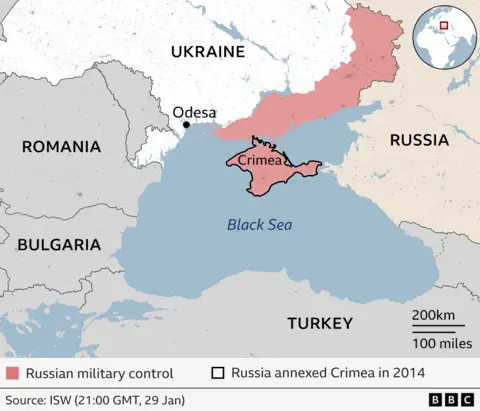
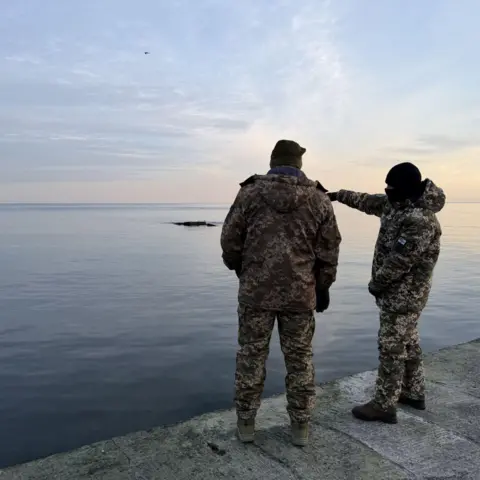
The tall, softly spoken 31-year-old Ukrainian Navy diver is part of a team of 20 tasked with de-mining the parts of the Black Sea still under Ukraine's control. Mines are some of the most insidious and long-lasting legacies of war. They remain active, and deadly, for decades; the ones at sea present additional risks, as they can drift with currents and storms.
The sea mines laid by Moscow at the start of the full-scale invasion – when Russian ships approached Odesa – are no different. And the danger is not theoretical: last summer, three swimmers were killed by mines off the Odesa coast. The commander of the navy's mine countermeasures group – a wry, sharp-eyed young man who goes by the callsign Fox – estimates the number of sea mines is in the thousands.
But they are not the only danger lurking underwater. Missiles, artillery shells, bombs, and unexploded ordnance were washed downstream to the sea when the Kakhovka dam was blown up in 2022. These too could be triggered to explode at any minute.
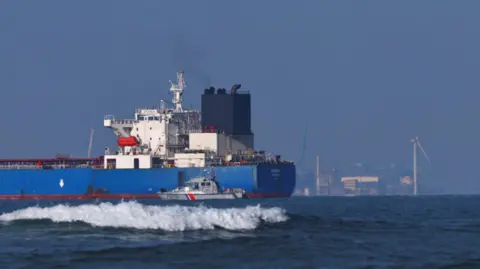
Despite the scale of the contamination, sea traffic has not come to a halt, and a significant number of merchant ships are still operating in the only maritime export corridor out of Ukraine. For Ukraine, the effort to clear the seabed is part of a broader attempt to keep the ports on the Black Sea usable, particularly by commercial ships that bring in much-needed revenue.
'While Russia may have an advantage on land and in the air, it does not at sea,' says navy spokesman Dmytro Pletenchuk, emphasizing the balance of power in maritime warfare. 'Here, Russia's main tactic - mass - does not work.'
Vitalii explains that the de-mining operation is painstaking and fraught with danger: 'We move carefully and extremely slowly so that the mine does not detonate,' he describes, highlighting the meticulous process of approaching potentially deadly objects. 'One second you move, then you stay still for some time.'
In the current conditions, the divers estimate that clearing the seabed will take decades, yet there is no alternative - the need for safe shipping routes will only grow more essential for Ukraine as the conflict continues. These brave divers will continue their vital work, one methodical second at a time.
The tall, softly spoken 31-year-old Ukrainian Navy diver is part of a team of 20 tasked with de-mining the parts of the Black Sea still under Ukraine's control. Mines are some of the most insidious and long-lasting legacies of war. They remain active, and deadly, for decades; the ones at sea present additional risks, as they can drift with currents and storms.
The sea mines laid by Moscow at the start of the full-scale invasion – when Russian ships approached Odesa – are no different. And the danger is not theoretical: last summer, three swimmers were killed by mines off the Odesa coast. The commander of the navy's mine countermeasures group – a wry, sharp-eyed young man who goes by the callsign Fox – estimates the number of sea mines is in the thousands.
But they are not the only danger lurking underwater. Missiles, artillery shells, bombs, and unexploded ordnance were washed downstream to the sea when the Kakhovka dam was blown up in 2022. These too could be triggered to explode at any minute.
Despite the scale of the contamination, sea traffic has not come to a halt, and a significant number of merchant ships are still operating in the only maritime export corridor out of Ukraine. For Ukraine, the effort to clear the seabed is part of a broader attempt to keep the ports on the Black Sea usable, particularly by commercial ships that bring in much-needed revenue.
'While Russia may have an advantage on land and in the air, it does not at sea,' says navy spokesman Dmytro Pletenchuk, emphasizing the balance of power in maritime warfare. 'Here, Russia's main tactic - mass - does not work.'
Vitalii explains that the de-mining operation is painstaking and fraught with danger: 'We move carefully and extremely slowly so that the mine does not detonate,' he describes, highlighting the meticulous process of approaching potentially deadly objects. 'One second you move, then you stay still for some time.'
In the current conditions, the divers estimate that clearing the seabed will take decades, yet there is no alternative - the need for safe shipping routes will only grow more essential for Ukraine as the conflict continues. These brave divers will continue their vital work, one methodical second at a time.