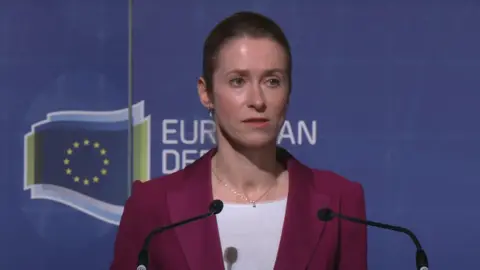
Europe must step up urgently to improve its defense and make NATO 'more European to maintain its strength,' because the US has shaken the transatlantic relationship to its foundation, the EU's foreign policy chief has warned.
The US would continue to be Europe's partner and ally, Kaja Kallas told a defense conference, but no great power had ever 'outsourced its survival and survived.'
Tensions with the US flared when President Donald Trump threatened to take over Greenland, a semi-autonomous Danish territory.
Kallas's remarks came after NATO leader Mark Rutte prompted a backlash when he said European lawmakers should 'keep on dreaming' if they thought Europe could defend itself without the US.
French Foreign Minister Jean-Noël Barrot reacted to Rutte's comments, stating, 'No, dear Mark Rutte. Europeans can and must take control of their security. Even the United States agrees. It's the European pillar of NATO.'
Kaja Kallas noted that under the Trump administration, Europe was 'no longer Washington's primary center of gravity,' emphasizing the need for a cultural shift towards joint European action.
She indicated that the US's transition away from Europe is structural and long-term, citing the special responsibilities of the 23 nations that are members of both the EU and NATO to sync their efforts.
Reflecting on the recent US-European rift over Greenland, Kallas pointed out a 'tectonic shift' in relations, marked by President Trump's threats to impose tariffs on European allies opposing his plans.
Mark Rutte was credited with calming tensions when the threat was dropped during talks on the fringes of Davos.
Last year, NATO member states pledged to increase overall spending to 5% of GDP by 2035 under pressure from Trump, with discussions around what percentage could be allocated towards national infrastructure.
Rutte remarked that for Europe to truly 'go it alone' on defense, spending would need to increase to 10% of GDP, along with developing its own nuclear capabilities.
As echoed by EU Defense Commissioner Andrius Kubilius at the conference, the US expects Europeans to take more responsibility for their defense as its presence on the continent diminishes.
The session underscored the European aim for independence and a more robust defense strategy, prompting discussions on NATO’s foundational purpose amid heightened tensions with Russia, exemplified by recent military actions in Ukraine.