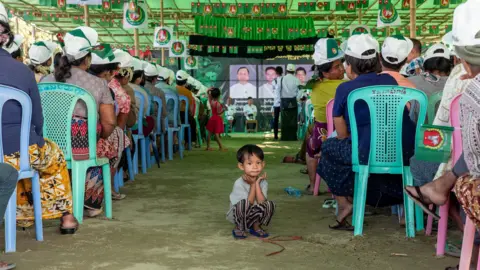
On a patch of rough ground near the Irrawaddy River, aspiring member of parliament and retired Lieutenant-General Tayza Kyaw tries to muster some enthusiasm from his audience with a speech promising them better times.
He is the candidate for the Union Solidarity and Development Party (USDP), backed by Myanmar's military, in Aungmyaythazan, a constituency in the city of Mandalay. The crowd of 300-400 clutch the branded hats and flags they've been given, but soon wilt in the afternoon heat, some dozing off.
Children run and play in between the rows of chairs. Many of these families are victims of the earthquake which badly damaged Mandalay and surrounding areas in March, and are hoping for a handout. They disappear the moment the rally finishes.
On Sunday, the people of Myanmar get their first opportunity to vote in an election since the military seized power in a coup nearly five years ago, setting off a devastating civil war.
But the poll, already delayed many times by the ruling junta, is being widely condemned as a sham. The most popular party, the National League for Democracy, has been dissolved, and its leader, Aung San Suu Kyi, is locked up in an undisclosed prison.
Voting, which will happen in three stages over a period of a month, will not even be possible in large parts of the country still consumed by war. Even where voting is taking place, it is marred by a climate of fear and intimidation.
When the BBC tried asking people at the rally in Mandalay what they thought of the election, we were told not to by party officials. They might say the wrong thing, one man explained – they don't know how to speak to journalists.
The number of plain-clothes military intelligence officers present there helps explain their nervousness. In a dictatorship which has criminalised liking Facebook pages criticising the election, or using the word revolution, even these staunchly pro-military party activists feared the consequences of allowing a foreign journalist the chance to ask uncensored questions.
The same fear lingers on the streets of Mandalay. Only one woman was brave enough to speak frankly, but we needed to find a private place to meet, and to conceal her identity, just to hear her view of the election.
This election is a lie, she said. Everyone is afraid. Everyone has lost their humanity and their freedom. So many people have died, been tortured or fled to other countries. If the military keeps running the country, how can things change?
He said he had to carry these weapons just to move about the village.
On his phone were images of his opponents: young men, raggedly dressed, with an assortment of weapons they may have smuggled from border regions of Myanmar or obtained from dead soldiers and police officers. One group, calling itself the Unicorn Guerrilla Force, was his toughest adversary. They never negotiated, he said. If we see each other we always shoot. That's the way it is.
Even a short distance from the apparently peaceful city life of Mandalay, the deep scars left by Myanmar's civil war, which is still far from over, are visible.
The military authorities imposed a new law in July criminalising any speech, organising, inciting, protesting, or distributing leaflets in order to destroy a part of the electoral process. In September three young people in Yangon were given sentences of 42 to 49 years each for posting stickers showing a bullet and a ballot box together.
Yet the junta leader Min Aung Hlaing seems confident this extraordinary election will give him the legitimacy he has not been able to acquire during his five catastrophic years in power. Many Burmese people will still go to the polling stations, whatever their views of the election.
We will vote one woman said, but not with our hearts.