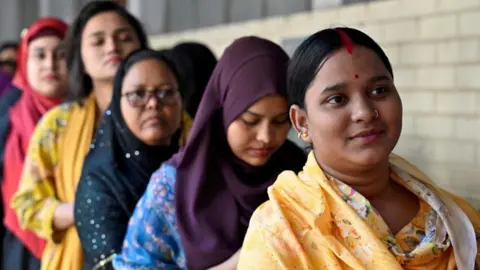
Votes are being counted in Bangladesh after its first election since student-led protests ousted Prime Minister Sheikh Hasina in 2024. More than 2,000 candidates are vying for 300 elected seats in parliament, though none are from the banned Awami League of Hasina, who fled after 15 years in power following a brutal security crackdown that left hundreds of protesters dead.
The election pits the centre-right Bangladesh Nationalist Party (BNP) against a coalition led by the Islamist Jamaat-e-Islami, which joined forces with a party born out of the student uprising. Results are expected on Friday, accompanied by widespread hope among voters for a return to democracy.
This marks the first time since 2008 that the outcome of a Bangladeshi election cannot be easily predicted, as previous elections were marred by allegations of rigging favoring Hasina's regime. Hasina faces serious legal issues, including a death sentence in absentia linked to her government's actions against the protests.
The ban on her Awami League contesting the polls casts doubt on the election's fairness, but voters report a newfound sense of choice. Over 120 million people were eligible to vote, comprised largely of young individuals under 37. Additionally, voters participate in a referendum on proposed constitutional changes aimed at fixing a troubled political system.
Interim leader Muhammad Yunus expressed optimism, stating that the country has ended the nightmare and begun a new dream. Turnout figures suggest a vibrant election atmosphere, with nearly a million police and military deployed to ensure order.
Tarique Rahman for the BNP and Shafiqur Rahman for Jamaat-e-Islami, both leading candidates, have laid out visions for the future amidst deep-rooted challenges such as dynastic politics and past governmental abuses.
Rahman, who aims for a platform of reconciliation and reform, might be viewed as a frontrunner. However, Jamaat-e-Islami's organized campaign seeks to challenge this narrative, advocating for justice and transparency. Observers note that despite their lack of representation in candidates, female voters are an integral part of the ongoing discourse.