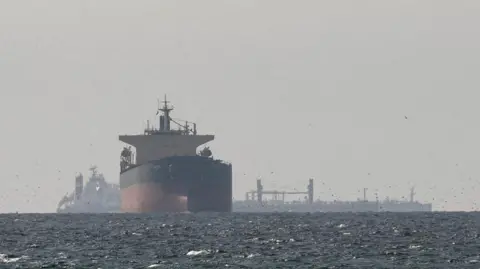
The US may act to seize a Russian-flagged oil tanker heading across the Atlantic to Europe, CBS News, the BBC's media partner in the US, reported. Two US officials told the broadcaster that American forces plan to intercept the ship, which historically has carried Venezuelan crude oil and is thought to be between Scotland and Iceland.
President Donald Trump said last month that he was ordering a blockade of sanctioned oil tankers entering and leaving Venezuela, a move the government there described as theft. Ahead of his seizure of the country's former leader Nicolás Maduro on Saturday, Trump had repeatedly accused Venezuela's government of using ships to bring drugs to American shores.
The US Coast Guard tried to board the Bella 1 last month in the Caribbean when it was believed to be heading towards Venezuela. They had obtained a warrant to seize the ship, accused of breaking US sanctions and shipping Iranian oil. It then dramatically changed course, as well as its name to the Marinera, reportedly reflagging from a Guyanan to a Russian vessel.
Its approach to Europe has coincided with the arrival of around 10 US military transport aircraft in the UK as well as helicopters. Russia says it is monitoring with concern the situation around the ship. CBS News reported that the two US officials said American forces preferred to seize the ship rather than sink it.
The Marinera is believed to be between Scotland and Iceland, with the distance and weather making a boarding difficult. If any US military operation were to be launched from the UK, then Washington would be expected to inform its ally. For now, the UK Ministry of Defence says it will not comment on other nations' military activities.
AIS (automatic identification system) tracking data for the tanker suggests it was in the North Atlantic approximately 2,000 km (1,200 miles) west of continental Europe on Tuesday. Under international law, vessels flying a country's flag are under the protection of that nation, but changing the ship's name and flag might not change much according to maritime experts.
Russia's foreign ministry remarked it was closely monitoring the situation, insisting that their vessels operate within international law. They expressed concerns about the disproportionate attention from the US and NATO forces towards the tanker, which is said to be sailing freely in international waters.
This unfolding situation signals a heightened geopolitical tension, particularly in relation to US military actions in Venezuela and their ramifications for international maritime law.
President Donald Trump said last month that he was ordering a blockade of sanctioned oil tankers entering and leaving Venezuela, a move the government there described as theft. Ahead of his seizure of the country's former leader Nicolás Maduro on Saturday, Trump had repeatedly accused Venezuela's government of using ships to bring drugs to American shores.
The US Coast Guard tried to board the Bella 1 last month in the Caribbean when it was believed to be heading towards Venezuela. They had obtained a warrant to seize the ship, accused of breaking US sanctions and shipping Iranian oil. It then dramatically changed course, as well as its name to the Marinera, reportedly reflagging from a Guyanan to a Russian vessel.
Its approach to Europe has coincided with the arrival of around 10 US military transport aircraft in the UK as well as helicopters. Russia says it is monitoring with concern the situation around the ship. CBS News reported that the two US officials said American forces preferred to seize the ship rather than sink it.
The Marinera is believed to be between Scotland and Iceland, with the distance and weather making a boarding difficult. If any US military operation were to be launched from the UK, then Washington would be expected to inform its ally. For now, the UK Ministry of Defence says it will not comment on other nations' military activities.
AIS (automatic identification system) tracking data for the tanker suggests it was in the North Atlantic approximately 2,000 km (1,200 miles) west of continental Europe on Tuesday. Under international law, vessels flying a country's flag are under the protection of that nation, but changing the ship's name and flag might not change much according to maritime experts.
Russia's foreign ministry remarked it was closely monitoring the situation, insisting that their vessels operate within international law. They expressed concerns about the disproportionate attention from the US and NATO forces towards the tanker, which is said to be sailing freely in international waters.
This unfolding situation signals a heightened geopolitical tension, particularly in relation to US military actions in Venezuela and their ramifications for international maritime law.