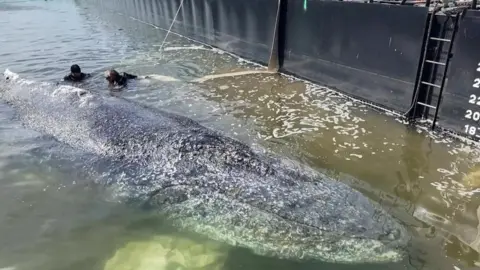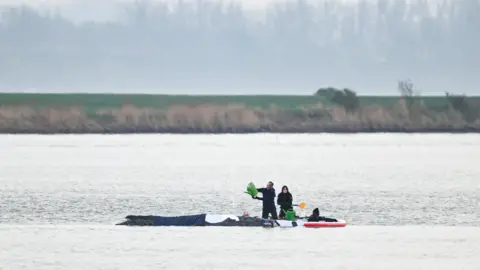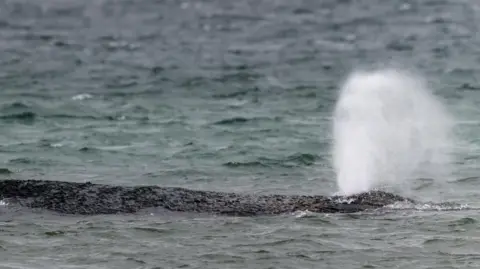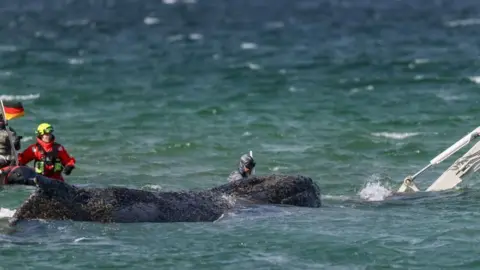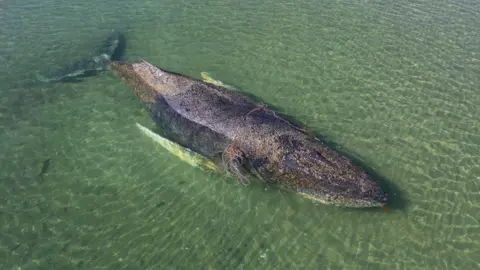
A humpback whale rescued after beaching itself in Germany has been found dead near a Danish island. The whale was first spotted stuck on a sandbank on 23 March, off the island of Poel on Germany's Baltic coast. It swam free in early May after a water-filled barge carried it into the North Sea. The operation was privately funded by two German entrepreneurs and spurred intense public debate, with critics suggesting it would only cause the animal distress.
A whale carcass was reportedly spotted on Thursday off the Danish island of Anholt, located between Denmark and Sweden. Authorities were not immediately able to confirm if it was the same whale. In a statement, the Danish Environmental Protection Agency said conditions on Saturday made it possible for the whale's identity to be verified, and its tracking device retrieved.
The agency mentioned that there are no concrete plans to remove the whale from the area or to perform a necropsy, as it does not currently pose a problem. However, it stressed that people should avoid approaching the whale, as it might carry diseases that can be transmitted to humans. There may also be a risk of explosion due to large volumes of internal gas caused by decomposition.
The whale, nicknamed 'Timmy' or 'Hope' by rescuers and German media, became stranded on Timmendorfer Beach in Lübeck Bay on 23 March. Initially, it managed to free itself but became stuck again several times. After a series of failed rescue attempts by German authorities, entrepreneurs Karin Walter-Mommert and Walter Gunz funded a private rescue. The whale was fitted with a tracking device and coaxed onto a transport ship.
Environmental minister Till Backhaus hailed the operation as an example for Germany, though wildlife groups expressed skepticism about the whale's chance of survival. The German Oceanographic Museum raised concerns that the whale was at risk of drowning due to its weakness, and Whale and Dolphin Conservation warned that it had suffered skin damage from the low salinity of the Baltic waters.
A whale carcass was reportedly spotted on Thursday off the Danish island of Anholt, located between Denmark and Sweden. Authorities were not immediately able to confirm if it was the same whale. In a statement, the Danish Environmental Protection Agency said conditions on Saturday made it possible for the whale's identity to be verified, and its tracking device retrieved.
The agency mentioned that there are no concrete plans to remove the whale from the area or to perform a necropsy, as it does not currently pose a problem. However, it stressed that people should avoid approaching the whale, as it might carry diseases that can be transmitted to humans. There may also be a risk of explosion due to large volumes of internal gas caused by decomposition.
The whale, nicknamed 'Timmy' or 'Hope' by rescuers and German media, became stranded on Timmendorfer Beach in Lübeck Bay on 23 March. Initially, it managed to free itself but became stuck again several times. After a series of failed rescue attempts by German authorities, entrepreneurs Karin Walter-Mommert and Walter Gunz funded a private rescue. The whale was fitted with a tracking device and coaxed onto a transport ship.
Environmental minister Till Backhaus hailed the operation as an example for Germany, though wildlife groups expressed skepticism about the whale's chance of survival. The German Oceanographic Museum raised concerns that the whale was at risk of drowning due to its weakness, and Whale and Dolphin Conservation warned that it had suffered skin damage from the low salinity of the Baltic waters.