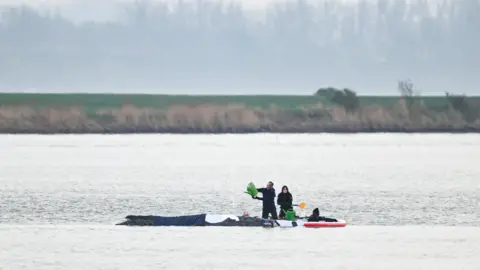
Rescuers are set to utilize air cushions in a new attempt to free a humpback whale that has been stranded off Germany's northern coast for weeks.
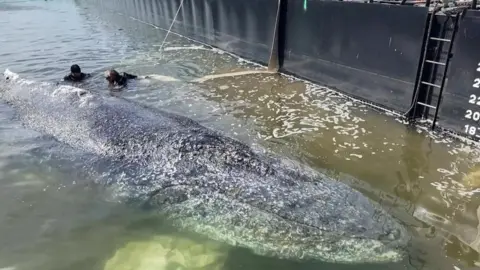
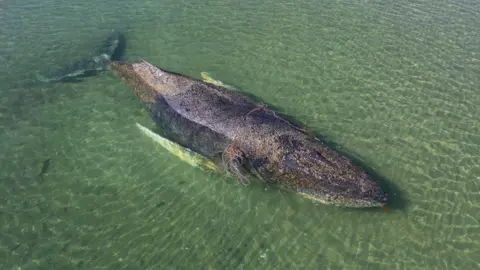
The whale, affectionately named Timmy by local media, was first spotted in the Baltic Sea at the beginning of March, far from its natural habitat, and is currently trapped in shallow waters off the island of Poel.
A private company is attempting to refloat the ailing mammal using its flippers, guiding it onto a tarp connected to a tug boat. The state of Mecklenburg-Western Pomerania has characterized this method as minimally invasive; however, wildlife experts warn that such interventions can carry significant risks, especially following prior unsuccessful rescue attempts.
Despite the experts' conclusion that the whale's chances of survival were minimal, Environment Minister Till Backhaus mentioned a reassessment that suggested a less invasive approach could be worthwhile.
The air cushions—similar in design to inflatable arm bands—will assist in bringing the distressed whale back to the surface, with hopes of eventually guiding it along Denmark's coastline and into the wider North Sea, possibly leading towards the Atlantic.
Although the injured whale is still showing signs of life, its current condition is described as severely weakened; thus, its prognosis remains critical yet not entirely hopeless.
Backhaus emphasized that given the potential for survival, it was justifiable to pursue this attempt while thanking the rescue initiative.
Authorities had initially considered allowing the majestic creature to pass in peace, but Timmy's situation has captured international media attention along with community empathy. The state government has also warned against the spread of misinformation regarding the whale's circumstances.
An exclusion zone has been set around the whale, highlighting the intervention's delicacy. Just recently, there was an incident involving a 67-year-old woman who jumped off a boat to approach the whale before being restrained by authorities.
According to Backhaus, the public's outpouring of concern indicates just how deeply the situation resonates with people. He reminded everyone to respect the emergency services' work and to adhere to protective measures in place.
The whale likely became ensnared in fishing nets before ultimately stranding itself on a sandbank, compounding its struggles with a dermatological condition resulting from the Baltic Sea's lower salt levels.
Efforts to help the whale have included using excavators to create a pathway for it, but guiding Timmy to the North Sea has failed, as it repeatedly drifted into shallower areas.
Greenpeace Germany, previously involved in rescue measures, has voiced opposition to the current stratagem, citing the whale's deteriorating health. Experts from the German Oceanographic Museum have assessed the whale's condition as critical, noting visible injuries from potential interactions with vessels and fishing equipment.
The precise trajectory that led this whale to the Baltic Sea remains unclear.