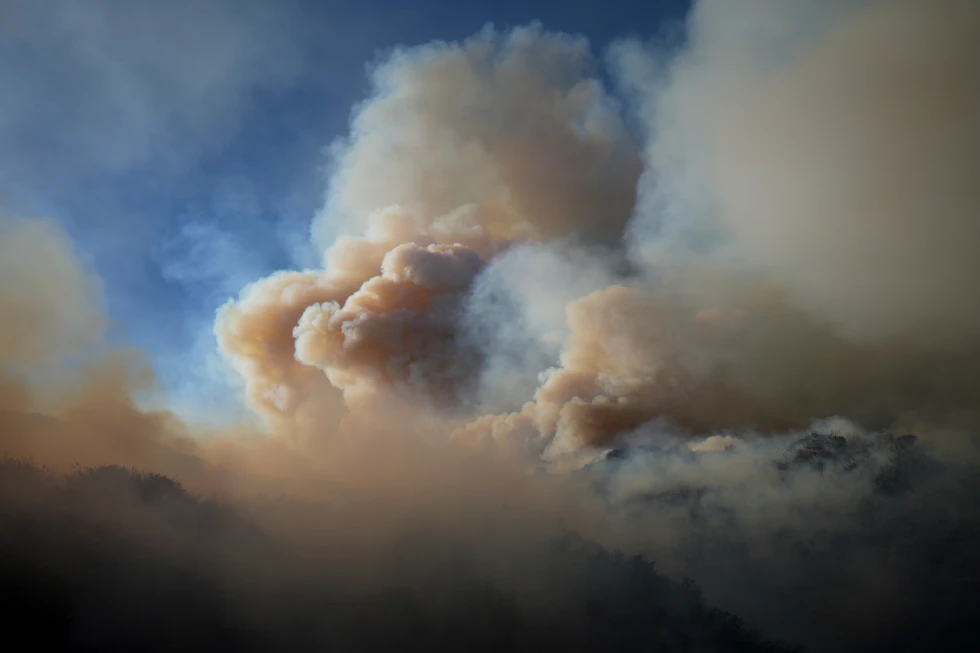
Chronic exposure to pollution from wildfires has been linked to tens of thousands of deaths annually in the United States, according to a new study.
The paper, published Wednesday in the journal Science Advances, found that from 2006 to 2020, long-term exposure to tiny particulates from wildfire smoke contributed to an average of 24,100 deaths a year in the lower 48 states.
“Our message is: Wildfire smoke is very dangerous. It is an increasing threat to human health,” said Yaguang Wei, a study author and assistant professor in the department of environmental medicine at Icahn School of Medicine at Mount Sinai.
Other scientists who have studied the death toll from wildfire smoke were not surprised by the findings.
“The estimates they’re coming up with are reasonable,” said Michael Jerrett, professor of environmental health science at the University of California, Los Angeles who was not involved in the study. “We need more of them. It’s only if we’re doing multiple studies with many different designs that we gain scientific confidence of our outcomes.”
‘These are real lives’ being lost due to wildfire smoke
The paper’s researchers focused on deaths linked to chronic exposure to fine particulate matter, or PM2.5 — the main concern from wildfire smoke.
These particles can lodge deep into lungs and enter the bloodstream. Short-term exposure can trigger coughing and itchy eyes, but longer term, they can make existing health problems worse and lead to a range of chronic and deadly health issues, including respiratory illness, cardiovascular and neurological diseases, and premature death.
“Wildfire smoke PM2.5 has emerged as significant environmental hazard in the U.S., and it’s driven by increasing frequency and intensity of wildfires due to climate change,” said Min Zhang, a postdoctoral student at the Icahn School and a study author.
Along with decades of forest mismanagement, growing development in fire-prone areas has expanded the “urban wildland interface,” increasing wildfire risk with real consequences for human health, said Jerrett.
“Nobody’s going to have ‘wildfire death’ on their death certificate unless the fire actually burned them or a tree fell on them or something like that,” said Jerrett. “But many of the people that are dying from this exposure are ones that are already more vulnerable. These are real lives that are being lost. This is not some arbitrary abstract statistical concept.”
How researchers approached the study
The study’s authors analyzed the link between annual average exposure to PM2.5 from wildfire smoke and deaths by county in the lower 48. They used federal mortality data across 3,068 counties of all causes of death and several specific ones — circulatory, neurological and respiratory diseases, as well as mental and behavioral disorders, tumors and endocrine, nutritional and metabolic diseases.
They also included deaths related to falls and transport accidents — which are unlikely to be linked to wildfire smoke — to ensure their other observations weren’t biased.
“We found no association for car accidents and falls, while for other diseases we found statistically significant effects,” said Wei. Deaths from neurological diseases saw the biggest increase with exposure to these particulates.
The study had the benefit of a large study population and included most causes of deaths in the U.S., yet inconsistencies may arise from the varying intensity of wildfire impacts across different areas. Additionally, other factors, such as personal smoking habits, were not accounted for, creating potential limitations in the findings.
Federal rollbacks on climate policy poses risks, authors say
The Trump administration’s rollbacks in climate change policy, even as the more destructive wildfires become more frequent in large part due to global warming, poses critical risks, the study’s authors said. Quantifying the deadly threat that PM2.5 from wildfires poses to human health shows the need for effective, urgent mitigation strategies, backed by Environmental Protection Agency monitoring and regulation, they said.