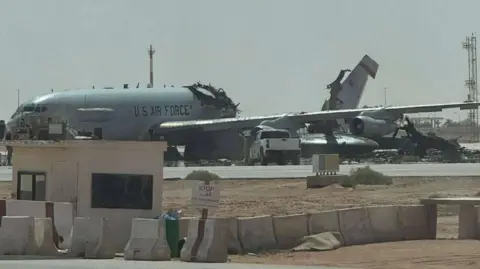
Verified images circulating on social media depict a heavily damaged US command and control aircraft, which has reportedly been destroyed at an air base in Saudi Arabia. The photographs show the E-3 Sentry aircraft in a critically compromised state, seemingly split in two.
These images first appeared on a Facebook page dedicated to US military news and have been confirmed to be taken at the Prince Sultan air base, which is located approximately 100 kilometers southeast of Riyadh. Analysis of the images reveals specific features, such as pylons and storage units, that match satellite imagery of the base.
Despite the severity of the incident, US Central Command has not publicly addressed the matter, and a request for comment from the BBC is still pending.
In related news, a US official disclosed to Reuters that twelve US personnel sustained injuries, with two in serious condition, during an Iranian military strike on the air base. The Wall Street Journal further reported that additional US refueling aircraft were also damaged in the attack.
According to Iranian state media affiliated with the Islamic Revolutionary Guard Corps (IRGC), a Shahed drone was responsible for hitting the E-3 aircraft. BBC verification teams have also observed an E-3 at this location in satellite images taken prior to the incident on March 11, though it's not confirmed if they are the same aircraft.
The aircraft’s tail number was visible in one of the verified photographs, and flight-tracking service Flightradar24 confirmed that it had been operational near the base on March 18.
A satellite image captured shortly before the incident also shows signs of a fire on the air base apron, although it remains unclear if this is related to the attack which resulted in the damage of the E-3.
The E-3 Sentry, an airborne warning and control system aircraft based on the Boeing 707 airliner, features a distinctive rotating radar domed on its fuselage. This design allows for long-range detection and tracking of potential threats during combat operations, providing commanders vital information for maintaining air control. The USAF reports that the E-3 has been in service since 1977 and is expected to remain operational until 2035.