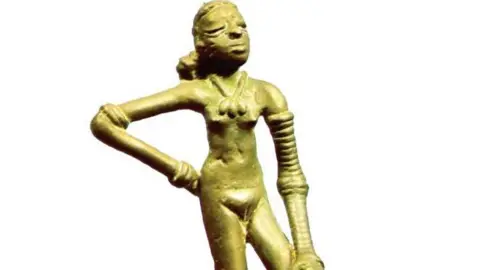
A newly released grade‑nine NCERT textbook depicted the bronze Dancing Girl figurine with its torso covered in dark shading, a decision that immediately sparked controversy among historians and educationists.
The Dancing Girl, discovered at Mohenjo‑daro and dating back to 2600 BCE, is one of the most recognizable artifacts from the Indus Valley civilisation, noted for its poised stance with one hand on the hip.
After public outcry, NCERT officials announced that the original, unaltered image has been reinstated in the digital version of the book and that forthcoming print editions will display the authentic photo.
Accusations of disfiguring the emblematic artifact have been leveled against the National Council of Educational Research and Training (NCERT), the autonomous body that drafts school curricula under the central education ministry.
NCERT director Dinesh Saklani confirmed to reporters that the censored image will be removed and that expert consultation led to the decision to restore the original illustration.
Since the textbook’s publication, the chapter on the Indus Valley has been a staple of the Indian school curriculum, and prior editions of the Dancing Girl have never obscured its torso.
While NCERT has not disclosed the exact reason for the initial modification, media reports speculate it may stem from concerns over nudity in school materials.
In an editorial, the Indian Express critiqued the alteration, arguing that the Dancing Girl’s significance lies in its confidence and presence, rather than modesty, and urged NCERT to trust students and women—both contemporary and ancient—with greater agency.
The textbook is part of NCERT’s new Arts Education Series introduced under the National Education Policy, aimed at integrating visual, performing, and literary arts into mainstream schooling.
The monument, housed in the National Museum in Delhi, showcases a girl adorned with ornaments, her hair tied in a bun, and is celebrated for its artistic detail and evidence of advanced metallurgy.