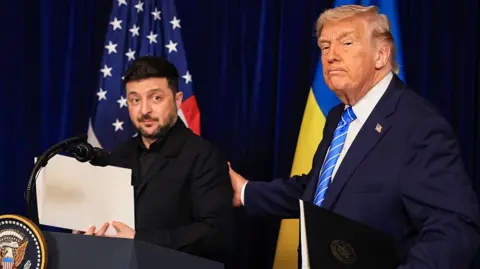
Russia, the US and Ukraine agree that a deal on ending almost four years of full-scale war is edging closer but, in the words of President Donald Trump, 'one or two very thorny, very tough issues' remain.
Two of the trickiest issues in Washington's 20-point plan involve territory and the fate of Europe's biggest nuclear plant, which is currently occupied by Russia.
The Kremlin agrees with Trump that negotiations are 'at a final stage', and Zelensky's next step is to meet European leaders in France on 6 January, but any one of the sticking points could jeopardise a deal.
Fate of Ukraine's industrial heartland coveted by Putin
Vladimir Putin has not budged from his maximalist demand for the whole of Ukraine's industrial Donbas, although Ukraine's Volodymyr Zelensky has offered a compromise.
Despite Russian forces occupying a significant portion of the Luhansk region in the east, Zelensky asserts that they cannot simply withdraw from the area, emphasizing the legal and humanitarian implications of losing such territory.
He proposed establishing a demilitarized zone in the Donbas, which would be policed by international forces, but gaining Putin's agreement on this matter seems unlikely.
Ukraine's huge nuclear power plant in Russian hands
Since March 2022, Russian forces have held the Zaporizhzhia nuclear plant under occupation. Although the plant is not currently generating electricity, its safeguarding remains an essential topic in discussions regarding peace.
Both countries have different visions for the plant, further complicating talks. Ukraine demands its international management to avoid any future mishaps, while Russia insists it remain under its control.
Lack of mutual trust despite positive rhetoric
The lack of trust between the two nations continues to hinder progress on critical issues. Zelensky has openly expressed doubt about Putin's commitment to peace.
Additionally, external factors, including security guarantees and economic reparations, further complicate negotiations. Ukraine seeks a robust military presence post-conflict, while Russia disregards the inclusion of NATO troops on Ukrainian soil.
Could Ukrainians hold a vote on a deal?
With significant public sentiment favoring peace, Zelensky proposes a popular vote to legitimize any agreements made. However, the Kremlin perceives this as a potential strategy to prolong negotiations.
The interplay of these complex issues makes the road to a peace agreement both challenging and fraught with uncertainty, as the international community watches closely.