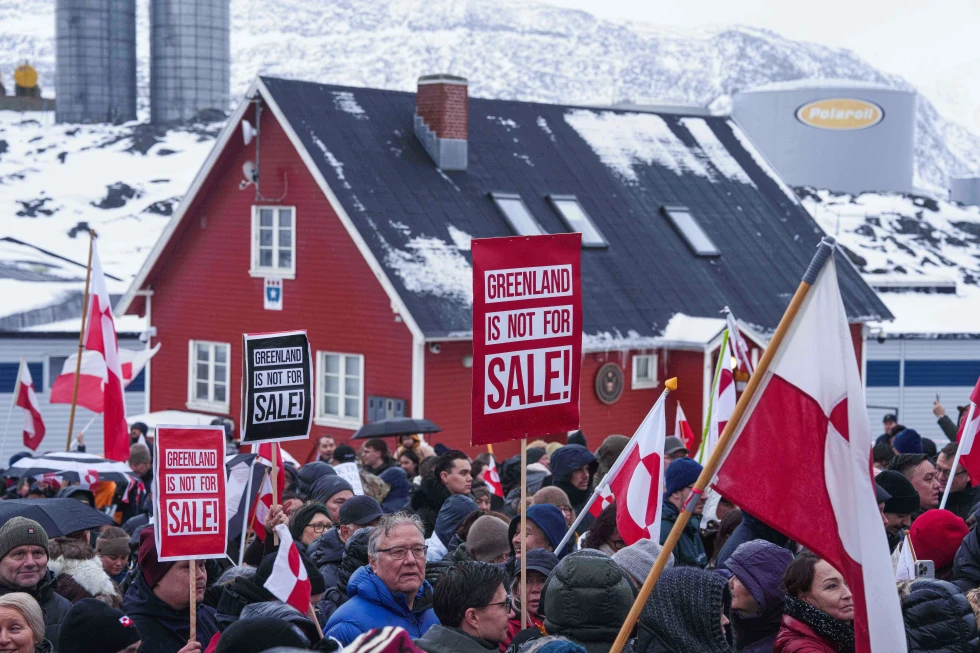
Washington (AP) — President Trump's recent attempts to seize Greenland have not only raised eyebrows internationally but also alienated many within his own Republican Party. A new AP-NORC poll indicates that approximately 70% of U.S. adults disapprove of how Trump is addressing the Greenland situation—a response that exceeds discontent regarding his overall foreign policy stance.
Even among Republican voters, traditionally his base, there is significant unease; roughly half disapprove of Trump's ambition to claim the icy territory as part of the U.S., attributing it to national security concerns against Russia and China. This shift of opinion is particularly marked among younger Republicans, with 60% expressing disapproval compared to only 40% of their older counterparts.
The poll, conducted February 5-8, reveals Trump’s Greenland stance as the lowest rating amid a series of other key issues where he enjoys higher approval, such as the economy and immigration.
Independent voters echo sentiments that critique Trump's aggressive pursuit, labeling it impractical and ill-conceived. As regional relationships grow increasingly strained, particularly illustrated during events like the Munich Security Conference, Trump's approval ratings for foreign policy remain steady, despite discontent over Greenland undermining his overall standing.
This landscape not only highlights emerging dissent among his supporters but signals potential vulnerabilities as the 2024 election approaches.
Even among Republican voters, traditionally his base, there is significant unease; roughly half disapprove of Trump's ambition to claim the icy territory as part of the U.S., attributing it to national security concerns against Russia and China. This shift of opinion is particularly marked among younger Republicans, with 60% expressing disapproval compared to only 40% of their older counterparts.
The poll, conducted February 5-8, reveals Trump’s Greenland stance as the lowest rating amid a series of other key issues where he enjoys higher approval, such as the economy and immigration.
Independent voters echo sentiments that critique Trump's aggressive pursuit, labeling it impractical and ill-conceived. As regional relationships grow increasingly strained, particularly illustrated during events like the Munich Security Conference, Trump's approval ratings for foreign policy remain steady, despite discontent over Greenland undermining his overall standing.
This landscape not only highlights emerging dissent among his supporters but signals potential vulnerabilities as the 2024 election approaches.