Africa's heads of state are gathering in the Ethiopian capital, Addis Ababa, for their annual meeting this weekend at a time when the continent's place in the world appears to be in flux. Canada's Prime Minister Mark Carney, speaking in Davos last month, described an arresting image of the future of international relations: either countries were at the table or they were on the menu. For Africa's leaders, who for years have been arguing that they should be dining at the top table, it was not an unfamiliar analogy. However, US President Donald Trump has accelerated a trend toward great-power dominance in international affairs and the abandonment of multilateralism. As indicated in the updated White House security strategy, some regions will not receive equal focus, reflecting an increasing pivot towards the Western hemisphere and the Middle East at the expense of Africa.
This leads to a pressing re-evaluation of relationships by less powerful nations, which traditionally relied on global bodies such as the UN or World Bank. Such changes raise the urgency of how the continent should navigate the new global order. Tighisti Amare from Chatham House warns of a risk of African countries falling behind if they fail to form a cohesive strategy. Already, the U.S. is engaged in bilateral deals centered on minerals and resources, bypassing collective bargaining.
The shift in U.S. policy is stark compared to the previous administrations, with Joe Biden's approaches failing to significantly improve relations, leading analysts to question whether African nations are truly prioritized in American foreign policy. Critically, as transactional deals proliferate, the bargaining power of African countries may diminish.
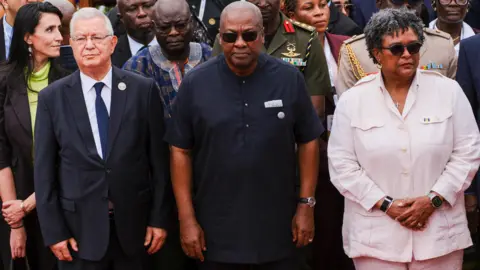
Despite these issues, leaders like Ghana's President John Mahama are advocating for greater sovereignty and self-sufficiency for Africa. His Accra Reset project calls for more investment in skills and coordinated industrialization, aiming for a united African front in trade negotiations and global engagements.
As discussions continue in Addis Ababa, the continent faces a critical junction. The potential for collective action exists, yet overcoming internal divisions remains a significant hurdle to secure Africa's rightful place at the global table.
This leads to a pressing re-evaluation of relationships by less powerful nations, which traditionally relied on global bodies such as the UN or World Bank. Such changes raise the urgency of how the continent should navigate the new global order. Tighisti Amare from Chatham House warns of a risk of African countries falling behind if they fail to form a cohesive strategy. Already, the U.S. is engaged in bilateral deals centered on minerals and resources, bypassing collective bargaining.
The shift in U.S. policy is stark compared to the previous administrations, with Joe Biden's approaches failing to significantly improve relations, leading analysts to question whether African nations are truly prioritized in American foreign policy. Critically, as transactional deals proliferate, the bargaining power of African countries may diminish.
Despite these issues, leaders like Ghana's President John Mahama are advocating for greater sovereignty and self-sufficiency for Africa. His Accra Reset project calls for more investment in skills and coordinated industrialization, aiming for a united African front in trade negotiations and global engagements.
As discussions continue in Addis Ababa, the continent faces a critical junction. The potential for collective action exists, yet overcoming internal divisions remains a significant hurdle to secure Africa's rightful place at the global table.