
In brief
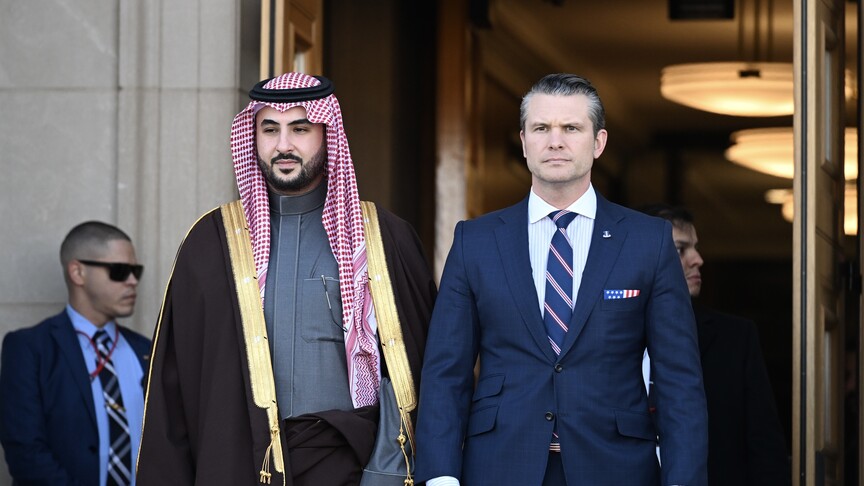
Saudi Defense Minister Prince Khalid bin Salman and U.S. Defense Secretary Pete Hegseth held a phone call on Monday to examine strategic defense cooperation and to address rising tensions in the region, including ongoing attacks by Yemen’s Houthi militia on Saudi territory. The discussion also touched on efforts to de‑escalate hostilities in Yemen, where the Saudi‑led coalition has fought the Houthis since 2015, and highlighted broader regional security concerns.
In a Monday phone conversation, Saudi Arabia’s Defense Minister Prince Khalid bin Salman and the United States’ Defense Secretary Pete Hegseth reviewed the state of strategic defense cooperation while addressing the escalating threat of Houthi attacks on Saudi territory, according to Anadolu‑Agency reports.
Prince Khalid said the discussion was prompted by a surge in hostile actions by Yemen’s Houthi militia, which has targeted Saudi airspace and infrastructure in recent weeks. The phone call also covered wider regional security developments and the U.S. and Saudi governments’ shared interest in mitigating the risk of further escalation in the Gulf and Yemen, the Saudi Press Agency noted.
Background on the Yemen Conflict
The Yemeni civil war began in 2015 after the Houthi movement seized the capital Sanaa and several other governmental strongholds in 2014. Since then, the Saudi‑led coalition has engaged in a sustained military campaign against the Houthis to restore the internationally recognised government, a fact highlighted by the Saudi Press Agency in its coverage of the ministers’ call.
Over the course of the conflict, the Houthis have launched drone, ballistic missile, and cyber attacks against Saudi cities, airports, and oil facilities, intensifying regional insecurity. These attacks have prompted Saudi Arabia to seek stronger bilateral security ties with the United States, as the two countries coordinate on counter‑terrorism and strategic deterrence.
Broader Regional Implications
Analysts see the call as part of a broader effort to curb the influence of Iran in Yemen, given the backing the Houthi group receives from that Tehran‑based state. The United States has been pushing for a diplomatic solution that also limits Iranian access to the region, a strategy that gains cues from the Saudi perspective. While the Saudi side stresses the need for a comprehensive de‑escalation plan, the U.S. side has articulated a commitment to collective defense and intelligence sharing, as reported by Ankara‑News and other outlets.
Both sides acknowledged that the situation in Yemen remains a critical threat not only to Saudi Arabia but also to the world's maritime security, especially in the Bab‑Al‑Mandab strait and the Red Sea corridor. The Aerial‑Defense Cooperation Agreement signed between the two nations last year is seen as a foundation for a joint response to Houthi incidents. However, the exact scope of the forthcoming collaboration remains to be delineated, leaving a gap in the public’s understanding of the operational details.
A notable element of the conversation was the reference to a “strategic defense cooperation” framework, which could involve joint fleet exercises, shared intelligence operations, and coordinated surveillance in the Arabian Sea. Experts from the Bureau of International Affairs note that such measures may help deter the Houthis from further maritime attacks, yet they also carry the risks of escalating tensions with other regional actors.
“We also discussed regional and global developments, including efforts to de‑escalate tensions in the region and the continued Houthi terrorist attacks against the Kingdom,” Prince Khalid wrote on X, citing the conversation with Hegseth.
The U.S. side has stressed that the partnership is designed to bolster both countries’ defensive posture while maintaining a calibrated response to any sudden Houthi offensive. According to a statement from the Pentagon released shortly after the call, the communications underscored the U.S. government’s readiness to support Saudi Arabia in counter‑terrorism operations and in maintaining maritime security in the Red Sea.
While the two officials agreed on cooperation and higher vigilance, they did not provide specific timelines or concrete actions, leaving stakeholders in the region uncertain about the next steps in countering the Houthi threat. This uncertainty reinforces the urgency of diplomatic efforts aimed at a broader arms‑de‑escalation and a sustainable political settlement in Yemen.
Given the timing of the call, which coincided with talks between the United States and Iran over economic and security issues, some observers suggest that the dialogue may have been intended to reassure Saudi leadership that the United States would remain supportive amid shifting U.S. foreign policy priorities. However, explicit confirmation of that strategy has not been released by either government.
In summary, the phone call between Prince Khalid bin Salman and Pete Hegseth marks a notable moment of bilateral engagement on security cooperation, reflecting a mutual concern over Houthi attacks and a shared commitment to regional stability. The development comes at a time when the Middle East remains a volatile theatre for competing geopolitical agendas, and the specific trajectory of this defense partnership will shape future responses to regional crises.


