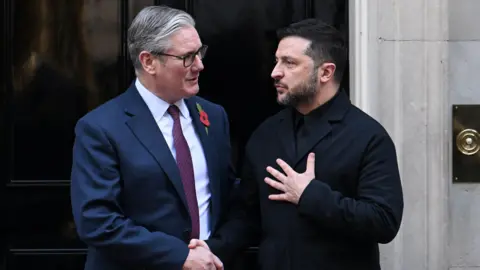
President Volodymyr Zelensky will meet key European leaders in London on Monday, as Ukraine's allies plan their response to an ongoing US push for Kyiv to accept concessions in peace talks.
The leaders of France and Germany will join Zelensky and Prime Minister Sir Keir Starmer at No 10 as they seek to ensure any deal deters a future Russian attack.
The high-level meeting follows three days of talks in Florida, where Zelensky's chief negotiator pushed for changes to a White House plan widely considered to accommodate central Kremlin demands.
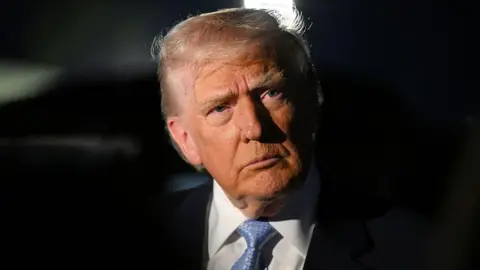
The US and Ukraine said there was progress, but US President Donald Trump appeared to criticize Zelensky on Sunday, saying he hasn't read the draft.
Trump told reporters that he was a little disappointed that President Zelensky hasn't yet read the proposal, that was as of a few hours ago. He continued: His people love it... [Russia] would rather have the whole country when you think of it, but Russia is, I believe, fine with it - but I'm not sure that Zelensky is fine with it.
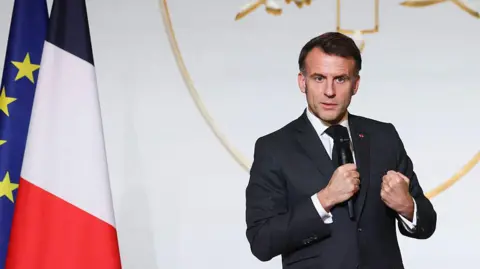
Mon-day's talks in London will feature Starmer, French President Emmanuel Macron, and German Chancellor Friedrich Merz, who represent the three Nato nations with the largest military budgets in real terms, with the exception of the US.
Downing Street said the meeting would focus on the ongoing peace negotiations and next steps, while UK cabinet minister Pat McFadden said it would explore ways to ensure Ukraine is able to decide its own future. He said there needed to be meaningful security guarantees in the event of a peace deal, not a toothless organisation.
The UK and France have led talks to assemble a so-called coalition of the willing - also referred to as the Multinational Force Ukraine - in order to offer future defence support, including a possible reassurance force deployed in the country.
It is not yet clear what functions it would perform, though diplomatic sources have indicated it would not be used to police a ceasefire line and would differ from a peacekeeping force in the sense that it would not be classed as impartial.
Germany and other European defence players, including Italy and Poland, have pledged forms of defence assistance but have expressed skepticism about the prospect of putting troops on the ground inside Ukraine - a proposal the Kremlin has said it would consider an escalation.
The White House has been pushing Kyiv and Moscow to swiftly agree to a multi-point plan to end the war.
But there has been little sign of a breakthrough. As well as security guarantees, negotiations remain particularly fraught around the issue of territorial concessions. The US has proposed Ukraine pulls its forces entirely out of eastern regions which Russia has attempted to take by force but has been unable to capture in full, in return for Russian withdrawals elsewhere and a cessation of fighting.
The talks in London are the latest attempt by Ukraine's European allies to carve out a role in the US-led efforts to end the war, which they fear will undercut their long-term interests in favour of a quick resolution. European leaders have pushed back against early versions of the US-led peace plan, which has been revised after criticism it was too favourable towards Russia.
Despite massive economic pressure and battlefield losses, the Kremlin has shown little sign it is willing to compromise on its key demands, including ruling out a any future path to Ukraine joining the Nato military alliance.