In brief
In a remarkable display of courage and dedication, local women in Himachal Pradesh's Spiti Valley are taking on the critical task of protecting snow leopards. Collaborating with conservationists and the forest department, these women are challenging traditional gender roles and making significant strides in wildlife conservation, which includes tracking and monitoring these elusive big cats. Their efforts not only contribute to the preservation of species but foster community respect for these majestic animals.
In one of India's coldest and most remote regions, a group of women have taken on an unlikely role: protecting one of Asia's most elusive predators, the snow leopard.
Snow leopards are found in just 12 countries across Central and South Asia. India is home to one of the world's largest populations, with a nationwide survey in 2023 estimating more than 700 animals.
One of the places they roam is around Kibber village in Himachal Pradesh state's Spiti Valley, a stark, high-altitude cold desert along the Himalayan belt. Here, snow leopards are often called the ghosts of the mountains, slipping silently across rocky slopes and rarely revealing themselves.
For generations, the animals were seen largely as a threat for attacking livestock. However, attitudes in Kibber and neighboring villages are beginning to shift as people increasingly recognize the snow leopard's role as a top predator and its importance in maintaining the region's fragile mountain ecosystem.
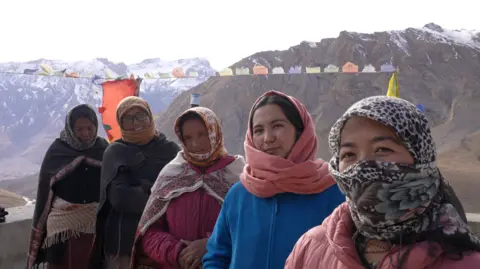
Nearly a dozen local women are now working alongside the Himachal Pradesh forest department and conservationists to track and protect the species, playing a growing role in conservation efforts.
Locally, the snow leopard is known as Shen, and the women have formed a group named Shenmo. They are trained to install and monitor camera traps that automatically photograph snow leopards as they pass.
Earlier, men used to go and install the cameras, and we kept wondering why couldn't we do it too, says Lobzang Yangchen, a local coordinator working with the Nature Conservation Foundation (NCF).
The women helped collect data for Himachal Pradesh's snow leopard survey in 2024, identifying individual animals by their unique rosette patterns on their fur.
Collecting data is demanding work, often taking place in the tough winter months. The women wake up early, finish household chores, and gather at a base camp before trekking several kilometers to camera sites at high altitudes where snow leopards roam.
Initially drawn to this work for a small income, the women have transformed how the community views snow leopards. Now we think their conservation is important, says Dolma Zangmo, a local resident.
Alongside their survey work, they help villagers access government insurance schemes for livestock and promote predator-proof corrals.
As climate change reshapes the fragile trans-Himalayan landscape, community participation is crucial for the conservation of species like the snow leopard. These women are not just assisting; they are becoming practitioners of wildlife conservation and monitoring.
In summation, their efforts are pivotal in supporting local livelihoods while preserving the ecological balance, demonstrating that empowered communities can lead to sustainable conservation practices.