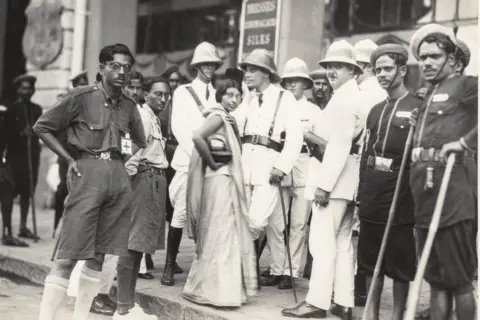
In India, a set of recently discovered photographs is drawing attention to the role of women in one of the country's biggest anti-colonial movements, known as the civil disobedience movement, led by Mahatma Gandhi during 1930-31.
The images do not simply capture female participation; they serve as visual proof of how women commanded political activity, often relegating men to the sidelines. In April 1930, Gandhi concluded his pivotal salt march, breaking the British monopoly on salt production—a potent symbol of colonial misrule. Following this, waves of civil disobedience protests erupted, with men and women alike participating in mass actions of defiance against British rule.
Historians recognize the civil disobedience movement as a critical turning point in Indian politics. Initially, Gandhi restricted women's participation in his salt march, but persistent female leaders soon proved their necessity in driving the movement forward.
Among the key findings is the Nursey album, an unexpected treasure of photographs documenting the movement, acquired by the Alkazi Foundation. This album offers a detailed narrative filled with unvarnished, active images of women leading protests, facing police, and demanding independence, which starkly contrasts with the previously staged depictions of political activity in India.
Women tragically underrepresented in prior portrayals now stand front and center, engaged in crafting contraband salt to evade colonial laws, participating in boycott processions, and even confronting police forces. The album captures a moment in history when these women were not merely participating but were pivotal leaders in the fight against British colonialism.
The historical narrative shifts here; these photographs allow for a broader understanding of the civil disobedience movement, emphasizing the empowerment and visibility of women in political activism. The images reflect not only the struggles but also the triumphs and community spirit of these courageous women who reshaped gender dynamics in a time of great political upheaval.
As these contributions gain recognition, the legacy of female leadership in the independence movement is cemented in historical documentation. Through opportunities for public leadership and civic engagement, these unsung heroines are finally receiving the acknowledgment they deserve, perhaps beginning a new chapter in the understanding of India's fight for freedom.