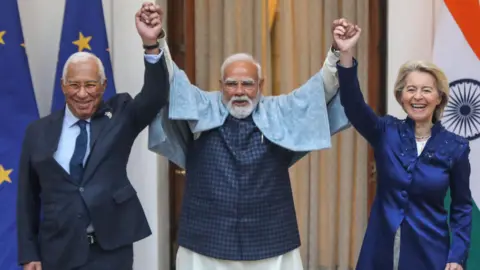
The European Union and India have announced a landmark trade deal after nearly two decades of on-off talks, as both sides aim to deepen ties amid tensions with the US.
We did it, we delivered the mother of all deals, European Commission President Ursula von der Leyen said at a media briefing in Delhi. Indian Prime Minister Narendra Modi called the pact historic.
The agreement allows free trade of goods between the bloc of 27 European states and the world's most populous country, which together constitute nearly 25% of global gross domestic product and a market of two billion people.
The deal will lead to substantial tariff cuts across a wide range of goods and services, alongside a joint security partnership.
During a bilateral summit in Delhi, von der Leyen and European Council President António Costa met Modi, announcing that the trade agreement would eliminate tariffs on most exports of chemicals, machinery, electrical equipment, aircrafts, and spacecraft.
Significantly, duties on motor vehicles, currently standing at as high as 110%, are set to drop to 10% under a quota of 250,000 vehicles, a substantial increase from the 37,000-unit quota India allowed for the UK.
In turn, India will reduce tariffs on European products like wine, beer, and olive oil. This agreement is expected to spur investment flows, access to European markets, and enhanced supply-chain integration.
Delhi has promised that almost all of its exports would receive preferential access to the EU market, particularly benefiting sectors such as textiles, leather, marine products, handicrafts, and jewelry.
Dairy, cereals, poultry, soy meal, and some fruits and vegetables were safeguarded to balance export growth with domestic priorities, according to Delhi's statements.
Both nations have established a mobility framework to ease professional travel restrictions between India and the EU.
This is India's biggest free trade agreement, Modi emphasized, stating it will facilitate market access for Indian farmers and small businesses, while boosting manufacturing and services.
The trade deal emerges as a countermeasure to the economic pressures both India and the EU face from the US, including tariffs imposed by former President Trump, which India seeks to navigate while still working towards a trade deal with the US that continues to face delays.
Leaders made remarks highlighting the geopolitical relevance of the agreement, with Von der Leyen commenting on the cooperation between the world's second and fourth largest economies as a response to global challenges.
Experts anticipate that while the trade agreement presents opportunities for sectors like textiles and farming in India, compliance with EU regulations could pose challenges.
The formal signing of the deal is expected later this year, pending approval from the European Parliament and member states, with the agreement regarded as a foundational step towards fostering stronger bilateral ties.