In brief
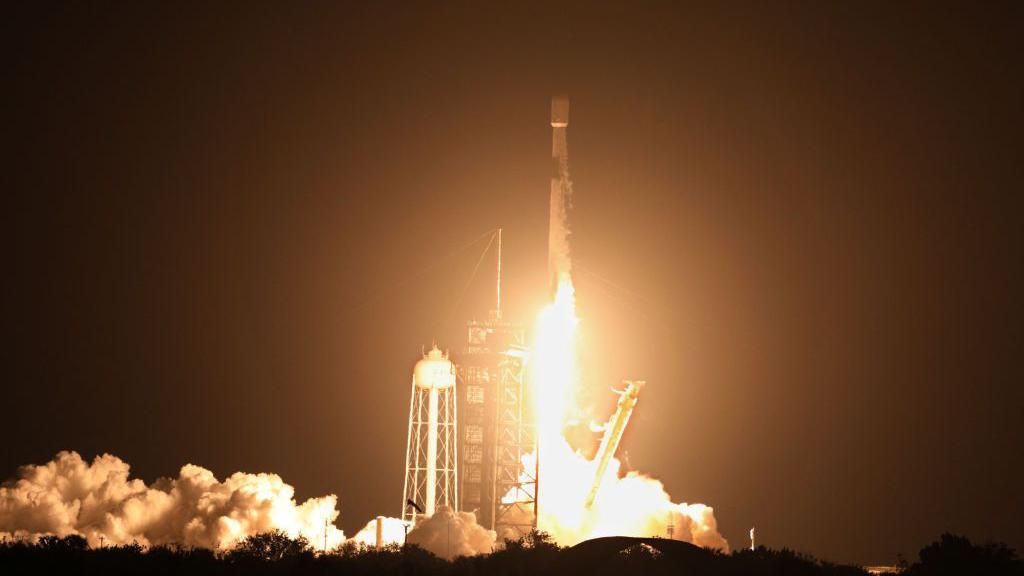
A de‑orbiting Falcon 9 upper stage, launched in January 2025, will hit the Moon’s surface in the early hours of August 5. NASA’s CNEOS predicts an impact that will launch a plume of dust over 50 km high and create a new crater roughly 17 m across. Scientists will use ground‑based telescopes, the Lunar Reconnaissance Orbiter and citizen‑science webcams to observe the event, hoping to refine impact models and probe the Moon’s subsurface. The incident also highlights the growing issue of orbital debris that can unknowingly traverse space and strike celestial bodies.
A Falcon 9 Upper Stage Set to Crash into the Moon
In the early hours of 5 August, a section of a SpaceX Falcon 9 rocket – launched in January 2025 with a Japanese lunar lander – is expected to collide with the Moon’s near side at a speed of approximately 2.43 km/s (5,400 mph). NASA’s Centre for Near‑Earth Object Studies (CNEOS) released the trajectory data after independent astronomers flagged the accidental collision course.
The impacting component is the upper stage, about the size of a five‑storey building and weighing a minimum of 4,000 kg on Earth. When it strikes the Moon, it will produce a plume of dust that could rise 50 km into space and spread sideways over time. Dr Matt Bothwell of the University of Cambridge explains, “This will be an impressive event – more dramatic than any explosion we’ve seen on Earth.”
While it is unlikely that the flash will be visible to the unaided eye, astronomers equipped with powerful telescopes will see a burst of light as the impact releases energy. The event will give scientists a unique chance to study the physics of a lunar impact, measure how high the dust reaches, and assess how much material is ejected and then falls back to the surface.
NASA will monitor the upper stage for training purposes and will later examine the impact site from orbit. The Lunar Reconnaissance Orbiter and South Korea’s Danuri probe will focus on the new crater, while a citizen‑science project invites amateur observers to film the explosion.
Such accidental crashes are not new. The last known rocket that hit the Moon was the Chinese Long March 3C upper stage in 2022. Decades earlier, Apollo missions deliberately launched objects into the Moon to gather data. This time, however, the collision stems from the sheer volume of orbital debris – with an estimated 54,000 objects larger than 10 cm lingering in space and roughly 17,000 t of human‑made material shot into orbit since 1957.
The incident serves as a cautionary reminder: every stray piece added to Earth’s orbit has the potential to travel into space and collide with other bodies. Dr Bothwell warns, “I think more people should be worried about space debris. A runaway cascade could happen if we keep adding more objects to orbit.”
Key facts for followers of the event:
- Impact time: 02:35 EDT (06:35 GMT) on 5 August
- Impact location: near Einstein Crater on the Moon’s daylight‑side, visible from Earth
- Projected crater size: around 17 m in diameter
- Plume height: up to 50 km
- Significance: real‑time study of lunar impact mechanics and a warning about escalating orbital debris
As the world watches the Moon’s surface, space agencies and the public alike are reminded of the delicate balance between exploration and the physical footprints of human technology in the cosmos.