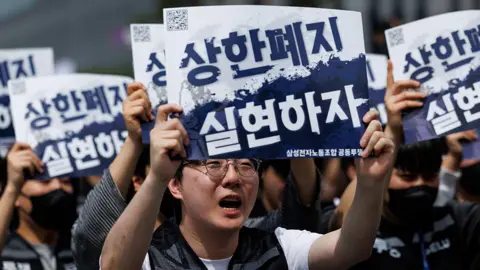
The largest union at Samsung Electronics has suspended a planned strike after reaching a last-minute tentative pay agreement with the South Korean technology giant.
This agreement has temporarily eased fears of disruption at the world's largest memory chipmaker during a boom in the building of artificial intelligence (AI) data centres.
The union, which represents nearly 48,000 workers, said industrial action that was due to begin on Thursday would be suspended while members vote on the deal from 22-27 May.
What is the dispute about?
The dispute centres on how to distribute profits generated by soaring demand for AI memory chips.
At issue is the distribution of bonuses between staff in memory chip divisions and those in other units. Samsung had planned to pay generous bonuses to 27,000 staff making memory chips – at least six times more than its workers making other chips and electronics.
The union expressed that 23,000 workers, who were making less advanced chips for companies like Tesla and Nvidia, should not be left behind in such bonus allocations.
This dispute had raised concerns over potential disruptions to chip production, with major implications for global supply chains and South Korea's export-driven economy. Samsung is the world's largest memory chipmaker by sales and a major supplier of chips used in AI data centres, smartphones, and laptops, accounting for roughly a fifth of South Korea's economic output.
What has Samsung said?
Samsung's operating profit in the January to March quarter surged about 750% from a year earlier due to booming demand for AI chips, pushing its market valuation past $1 trillion in May. The company had previously noted that its rivals, such as SK Hynix, have eliminated bonus caps, leading to higher bonuses being awarded to their workers.
The tentative agreement suggests that Samsung is willing to review its bonus structure to remain competitive in the industry.
After the announcement of the agreement, Samsung's shares rose by more than 5%, reflecting investor relief over the resolution of the imminent strike.
What impact could a strike have?
Experts estimated that a strike could impact Samsung's operating profit by 21 trillion to 31 trillion won ($14.08 billion to $20.79 billion), highlighting the significance of the company not only within South Korea’s economy but also globally.
A South Korean court has granted Samsung an injunction to ensure that any potential industrial action would not disrupt its operations. The injunction requires that staffing levels for safety and maintenance must remain at normal levels, forbidding the union from actions that might obstruct the flow of work.