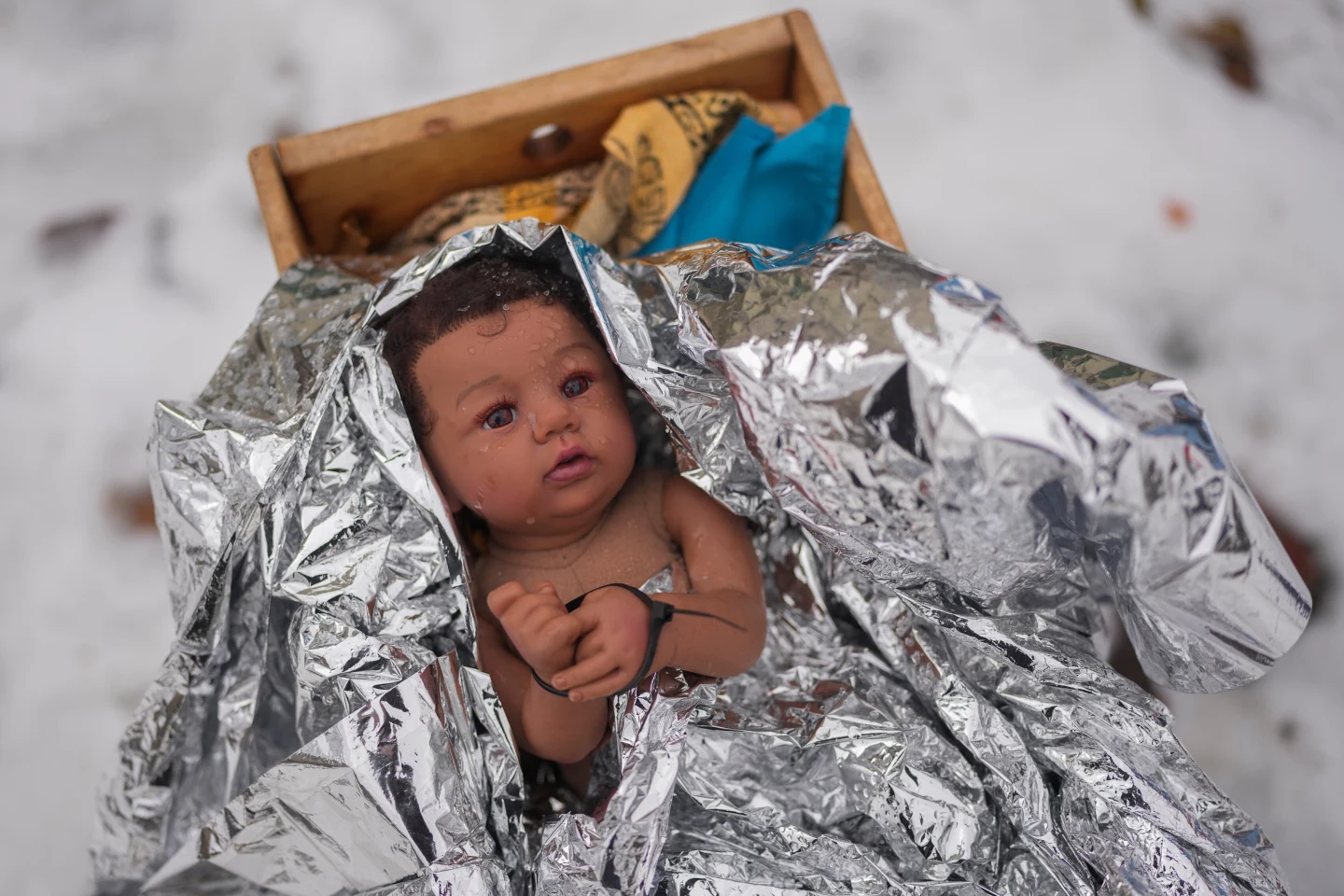
DEDHAM, Mass. (AP) — One baby Jesus lays in a manger in the snow, wrapped in a silver emergency blanket with his wrists zip-tied. Mary stands nearby outside the Lake Street Church in Evanston, Illinois, wearing a plastic gas mask and flanked by Roman soldiers in tactical vests labeled “ICE.”
In another Chicago suburb, not far from an Immigration and Customs Enforcement facility that has drawn protests over detentions, a sign at the manger outside the Urban Village Church says “Due to ICE activity in our community the Holy Family is in hiding.” Over a thousand miles away, the Christ child went missing from a nativity scene at St. Susanna Parish in Dedham, Massachusetts, replaced by a hand-painted sign: “ICE was here.”
These stark reimaginings of Christ’s birth are drawing praise and outrage as churches turn the Christmas tableau into a commentary on federal immigration enforcement. Their creators argue they are placing the ancient story in a contemporary frame, portraying the Holy Family as refugees to reflect the fears of separation and deportation faced by many families today.
Supporters say the Bible is on their side, while critics label the displays as sacrilegious and politically divisive. The archdiocese in Massachusetts has ordered that the manger must be “restored to its proper sacred purpose.”
The recent surge in immigration enforcement has intensified debates in communities opposed to these measures. In September alone, at least 2,000 arrests took place in Illinois and Massachusetts.
These artistic choices represent a heartfelt response to the community's climate of fear due to increasing detentions. As Rev. Michael Woolf from Lake Street Church notes, Christmas offers an opportunity for public art to provoke dialogue about pressing issues. Previous nativity scenes have depicted Jesus in rubble and even in polluted waters to comment on various crises.
While some parishioners and clergy defend these displays as necessary reflections of their community's struggles with migration issues, others view them as inappropriate for a place of worship. The response has been mixed, with some challenging the messages and seeking church compliance with traditional interpretations.
The debate continues as communities reflect on their values around immigration, safety, and the role of faith in politics. Activists within the church are calling for more engagement with actual refugee struggles over symbolic representations in seasonal displays.