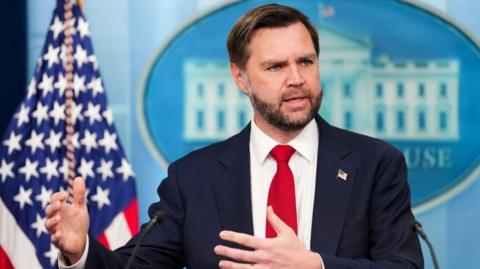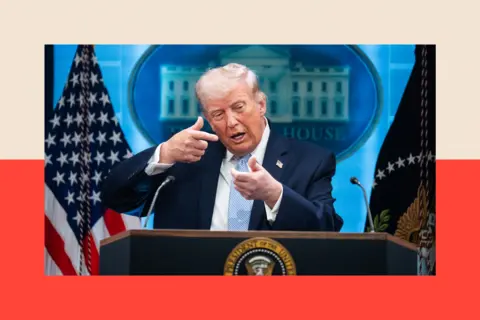
In the midst of an Easter lunch at the White House, President Donald Trump casually joked about the high expectations placed on Vice President JD Vance regarding a potential peace deal to end the war in Iran. During a recent East Room event, Trump quipped, 'If it doesn't happen, I'm blaming JD Vance,' garnering laughter from attendees, which included key administration figures like Vice President Marco Rubio and Defense Secretary Pete Hegseth. Conversely, he asserted, 'If it does happen, I’m taking full credit.' This encapsulates the daunting position Vance finds himself in as he assumes leadership of the US delegation in negotiations with Iran in Pakistan.
Vance's mission carries heavy political implications, both domestically and internationally. As the atmosphere in the Middle East remains fraught, his challenge is not only to broker a breakthrough in talks but also to satisfy a spectrum of stakeholders who have shown deep distrust following a tumultuous military campaign.
The success of these negotiations is critical for Vance if he hopes to gain legitimacy on the global diplomatic stage. He faces sharp scrutiny from US allies eager to see tangible results; failure to deliver could diminish his standing before allies and critics alike, as stated by an anonymous European official: 'Vance needs to step into the room and deliver something, otherwise he will be diminished.'
The complexities of these negotiations extend well beyond simply drafting an agreement. Vance must consider the interests of the Trump administration, particularly in the face of inconsistent messaging from Trump himself, who has oscillated between advocating for aggressive postures and calling for peace. Assurances from allies in the region suggest a collective hope that America is serious about achieving a sustainable resolution to the conflict. As Vance embarks on this pivotal mission, he carries not only the burden of his own political future but also the weight of international expectations.
Vance's mission carries heavy political implications, both domestically and internationally. As the atmosphere in the Middle East remains fraught, his challenge is not only to broker a breakthrough in talks but also to satisfy a spectrum of stakeholders who have shown deep distrust following a tumultuous military campaign.
The success of these negotiations is critical for Vance if he hopes to gain legitimacy on the global diplomatic stage. He faces sharp scrutiny from US allies eager to see tangible results; failure to deliver could diminish his standing before allies and critics alike, as stated by an anonymous European official: 'Vance needs to step into the room and deliver something, otherwise he will be diminished.'
The complexities of these negotiations extend well beyond simply drafting an agreement. Vance must consider the interests of the Trump administration, particularly in the face of inconsistent messaging from Trump himself, who has oscillated between advocating for aggressive postures and calling for peace. Assurances from allies in the region suggest a collective hope that America is serious about achieving a sustainable resolution to the conflict. As Vance embarks on this pivotal mission, he carries not only the burden of his own political future but also the weight of international expectations.