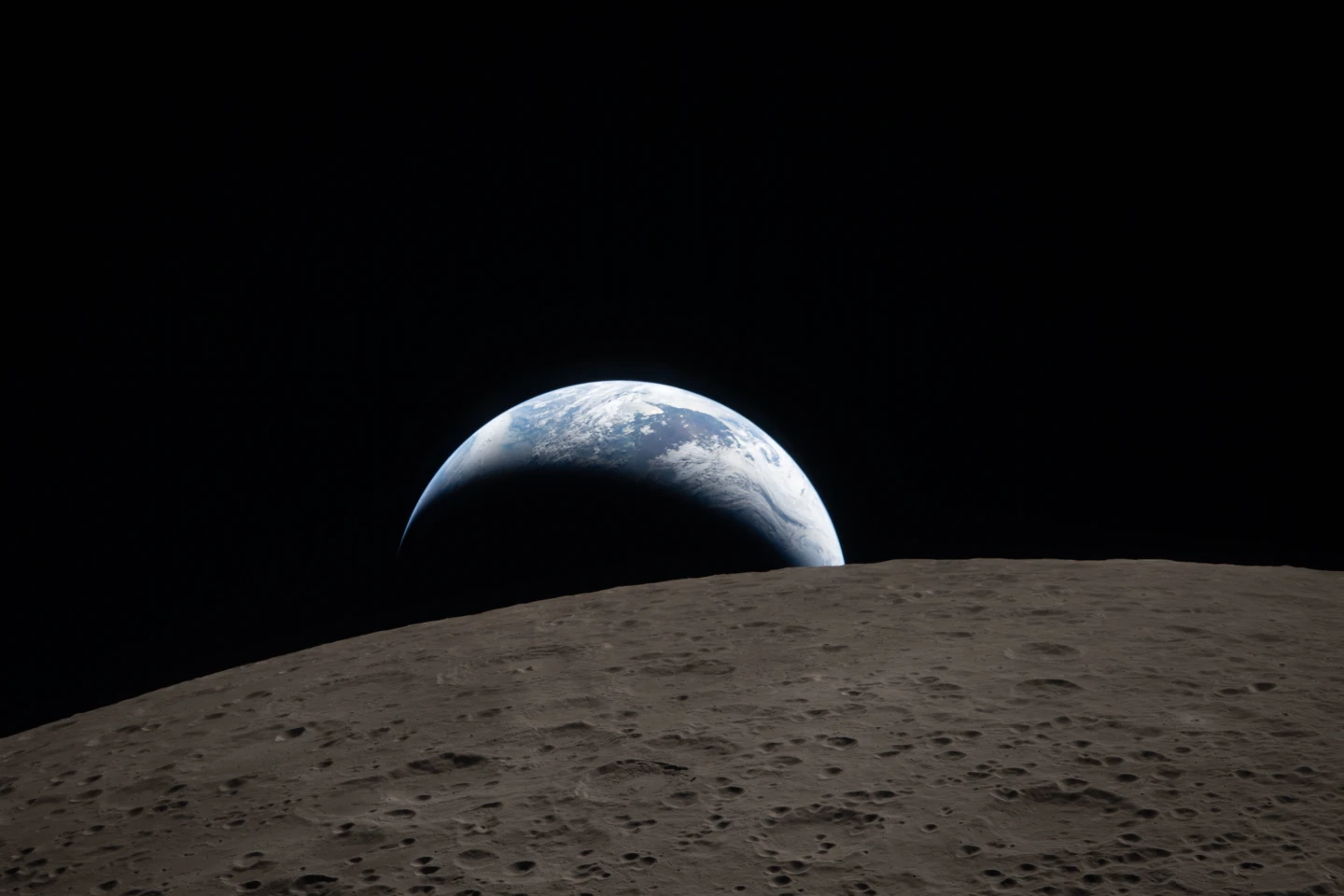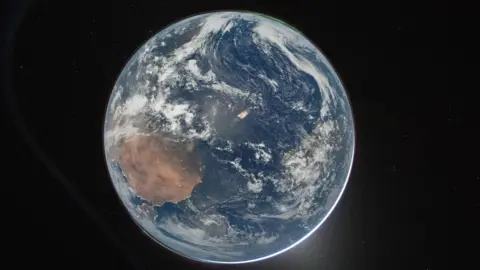
NASA has shared the first high-resolution images of Earth taken by the Artemis II crew as they pass the halfway point between Earth and the Moon. The mission's commander, Reid Wiseman, took the spectacular images after the crew completed a final engine burn that set them on a trajectory towards our closest celestial neighbor.
At about 07:00 BST, NASA's online dashboard showed the Orion spacecraft was now 142,000 miles (228,500 km) from Earth and 132,000 miles from the Moon. Astronaut Christina Koch said the crew collectively expressed joy upon hitting the milestone, which was achieved around two days, five hours, and 24 minutes after the launch.
The first image, titled Hello, World, reveals the Atlantic Ocean framed by the glow of the atmosphere, showing Earth as it eclipses the Sun alongside green auroras at either pole. The striking image depicts the planet upside down, showcasing the western Sahara and Iberian peninsula on the left and the eastern portion of South America on the right, with Venus visible in the lower right corner.
Wiseman also captured an image from within the Orion capsule as they performed a trans-lunar injection burn, transitioning out of Earth’s orbit. This represents the first time humans have traveled beyond Earth's orbit since 1972, with the Artemis II mission set to loop around the far side of the Moon before returning to Earth on April 10.
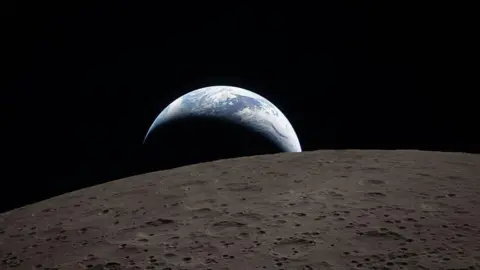
As the crew enjoyed the views, mission specialist Jeremy Hansen remarked on the beautiful view of the dark side of Earth, lit by the Moon. Wiseman also humorously requested advice on cleaning the spacecraft's windows, which had become smudged from their excitement to gaze at the universe. NASA's latest images stand in stark contrast to similar views captured during the Apollo 17 mission, highlighting advances in technology and the enduring allure of Earth from space.
At about 07:00 BST, NASA's online dashboard showed the Orion spacecraft was now 142,000 miles (228,500 km) from Earth and 132,000 miles from the Moon. Astronaut Christina Koch said the crew collectively expressed joy upon hitting the milestone, which was achieved around two days, five hours, and 24 minutes after the launch.
The first image, titled Hello, World, reveals the Atlantic Ocean framed by the glow of the atmosphere, showing Earth as it eclipses the Sun alongside green auroras at either pole. The striking image depicts the planet upside down, showcasing the western Sahara and Iberian peninsula on the left and the eastern portion of South America on the right, with Venus visible in the lower right corner.
Wiseman also captured an image from within the Orion capsule as they performed a trans-lunar injection burn, transitioning out of Earth’s orbit. This represents the first time humans have traveled beyond Earth's orbit since 1972, with the Artemis II mission set to loop around the far side of the Moon before returning to Earth on April 10.
As the crew enjoyed the views, mission specialist Jeremy Hansen remarked on the beautiful view of the dark side of Earth, lit by the Moon. Wiseman also humorously requested advice on cleaning the spacecraft's windows, which had become smudged from their excitement to gaze at the universe. NASA's latest images stand in stark contrast to similar views captured during the Apollo 17 mission, highlighting advances in technology and the enduring allure of Earth from space.