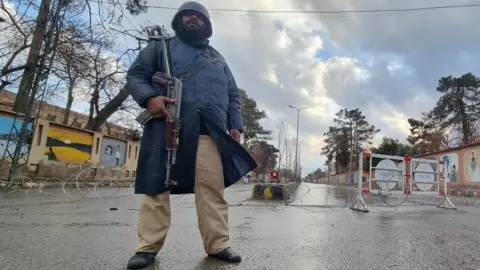
Pakistan's military says it has killed at least 92 militants blamed for deadly coordinated attacks in the south-western Balochistan province on Saturday.
The military reported that 15 security personnel and 18 civilians were also among the dead, accusing India of supporting the militants, a claim that Delhi has repeatedly denied.
The Balochistan Liberation Army (BLA) rebel group had claimed responsibility for the attacks, asserting that dozens of soldiers were killed in the assaults.
Both sides' claims have yet to be independently verified. The escalation of violence marks one of the deadliest days in the impoverished province, where Pakistan’s government has been battling ethnic insurgent groups for decades.
In a statement released late on Saturday, the military accused militants of carrying out multiple attacks aimed at civilians around the provincial capital, Quetta, and other cities.
The military launched “clearance” operations in response, claiming to have “successfully thwarted the evil design” of the rebels. Significant security measures were implemented, including sealing off key administrative buildings in Quetta, jamming mobile networks, and suspending regional train services.
Prime Minister Shehbaz Sharif praised the military's actions, pledging to “continue the war against terrorism until its complete eradication.” On the day of the attacks, militants armed with grenades and guns targeted police, paramilitary installations, as well as government and prison facilities across 12 cities and towns in the province.
The BLA has accused the federal government of exploiting the region’s wealth of mineral resources without benefiting the local populace. Some local activists also allege enforced disappearances by security forces, a claim that Islamabad denies.
The conflict in Balochistan has roots dating back to 1948, shortly after Pakistan's independence, driven by grievances over exploitation and demands for greater autonomy. The region is rich in natural resources yet remains the least populated area in the country, highlighting the disparity between wealth and population.