When Matthias Huss first visited Rhône Glacier in Switzerland 35 years ago, the ice was just a short walk from where his parents would park the car.
When I first stepped onto the ice... there [was] a special feeling of eternity, says Matthias. Today, it’s half an hour from the same parking spot and the scene is very different. Every time I go back, I remember how it used to be, recalls Matthias, now director of Glacier Monitoring in Switzerland (GLAMOS), reminiscing about the glacier's appearance in his childhood.
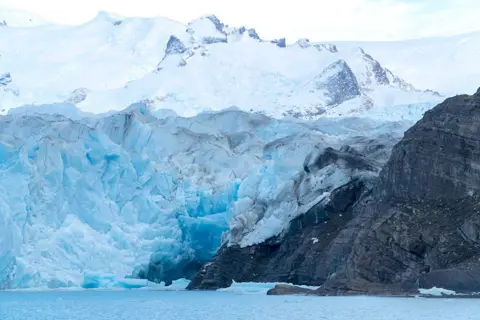
Similar stories are recounted globally as glaciers retreat rapidly due to climate change. A recent report from the World Meteorological Organization indicated that in 2024, glaciers outside Greenland and Antarctica lost around 450 billion tonnes of ice, equivalent to a block of ice 7km (4.3 miles) in dimension—enough to fill 180 million Olympic swimming pools.
Glaciers are melting everywhere in the world, states Prof. Ben Marzeion from the Institute of Geography at the University of Bremen. He emphasizes the increasingly hostile climate for these frozen rivers due to global warming. Switzerland’s glaciers have seen a dramatic loss of a quarter of their mass in just the past decade.
Dr. Huss notes that quantifying this melt is challenging, but photographic evidence vividly depicts the changes. Satellite images show significant alterations in the Rhône Glacier since 1990, where glaciers once stood proudly, now sprawling across lakes.
The phenomenon of glacier melt, previously considered extreme at 2% loss annually, has greatly escalated with 6% of Switzerland's glacier ice disappearing in 2022 alone—a shocking indication of accelerated warming trends.
While glaciers have experienced natural cycles of growth and retreat over millennia, the pace of current losses is unprecedented and heavily influenced by human activity through increased carbon emissions.
Despite the somber outlook, there is a glimmer of hope. Research suggests that stabilizing global temperatures to 1.5C above pre-industrial levels could preserve half of the remaining ice across mountain glaciers. However, the current trajectory toward a potential warming of 2.7C by century's end poses a grave threat to ice reserves.
The impact of glacier loss extends beyond scenic views. It holds critical implications for mountain communities that rely on glacial meltwater for agriculture, drinking water, and hydropower. For instance, about 800 million people in Asia depend on this meltwater, particularly during dry seasons.
Prof. Regine Hock reflects on the magnitude of change: It’s sad; but we have it in our hands to influence these outcomes through decarbonization efforts.”