
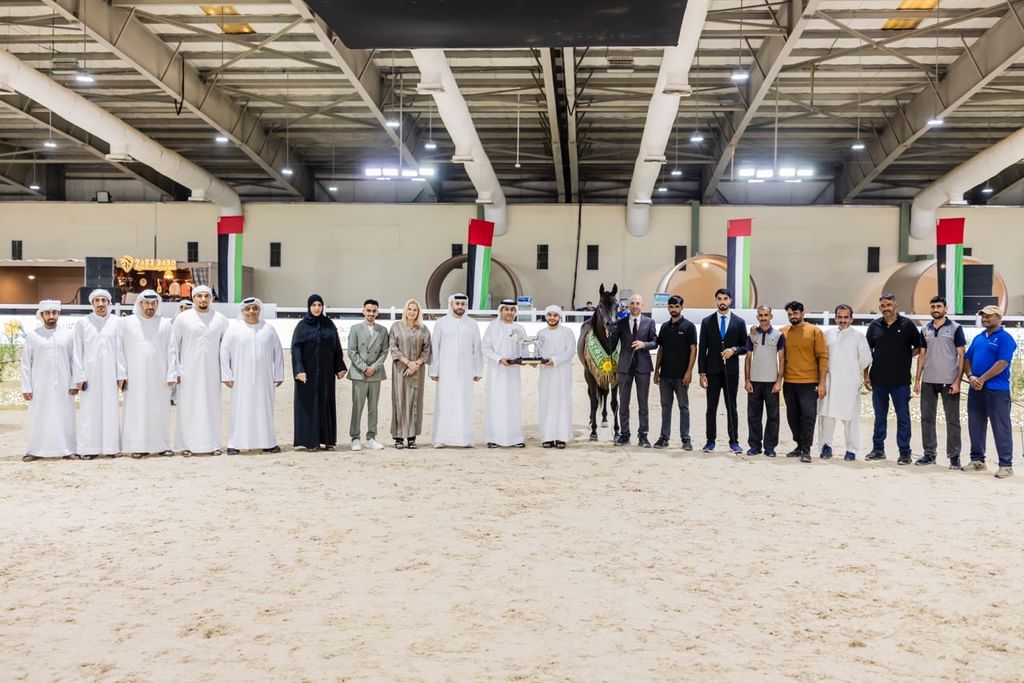
In a decisive finish at the Grand Hall of Boudheib Academy on 2 November 2026, JS Al Sultan, bred and owned by Al Noor Stud, seized the gold medal in the stallions category of the UAE National Arabian Horse Championship, a highlight of the four‑day competition organized by the Emirates Arabian Horse Society (EAHS) as part of its 2026‑2027 season programme (WAM).
The championship drew 500 horses representing 267 owners, competing for a total prize purse of AED 4.47 million, underscoring the event’s prominence and the UAE’s pivotal role in Arabian horse breeding and show circuits (WAM).
EAHS Director‑General Mohammed Ahmed Al Harbi presided over the final day’s competitions and personally crowned the winners in the presence of a host of horse owners, breeders and stud managers gathered from across the UAE (WAM).
JS Al Sultan’s victory in the stallions competition added to a series of notable performances across the championship’s multiple disciplines. In the Yearling Fillies division, Al Aryam Hames, owned by Sheikh Rashid bin Hamdan bin Zayed bin Sultan Al Nahyan, took gold, while AJ Saalmah of Amara Stables claimed silver and D Faqeehah from Dubai Arabian Horse Stud earned bronze (WAM).
In the Junior Fillies competition, which open to two‑ and three‑year‑olds, D Sdeirah of Dubai Arabian Horse Stud topped the leaderboard with gold, followed by Al Aryam Aneeda of Al Aryam Arabians for silver and D Faqeehah, again representing Dubai Arabian Horse Stud, claiming bronze (WAM).
The Mares division saw RK Naderah of Al Jawaher Stud win gold, with AJ Najwa of Khaled Al Omairi taking silver and Al Aryam Abla of Al Aryam Arabians earning bronze (WAM).
Yearling Colts champions included Emperor BHM of Bin Humaila Stud, who secured gold, followed by RA Al Murr of Ras Al Khaimah Stud with silver and Sahm Al Dar, owned by Mohammed Al Jawaan Al Shamsi, taking bronze (WAM).
In the Junior Colts category for two‑ and three‑year‑olds, Ghasham AH of Ahmed Saeed Al Hameli took gold, with Sarab BHM from Bin Humaila Stud slotted in for silver and ALA Sinjar of Mohammed Butti Ali Al Abdouli earning bronze (WAM).
Event Context and Significance
The championship’s scale—500 participants and a prize fund surpassing four million dirhams—highlights the UAE’s deep commitment to preserving and promoting the Arabian horse. By assembling such a diverse field, the EAHS reinforces the country’s reputation as a leading centre for the Arabian horse sector, both domestically and internationally (WAM).
Al Noor Stud, the breeding operation that produced JS Al Sultan, follows a long tradition of producing high‑quality stallions prized for conformation, temperament and performance. While the source does not delve into the specific genetic lines or training regimes of JS Al Sultan, the breeder’s presence among the gold‑medal recipients signals continued success for its program in the competitive arena (WAM).
Fahad Yas of Bakheet Saeed Al Ketbi received silver in the stallions category, while Al Aryam Baree of Al Aryam Arabians secured bronze, illustrating the depth of talent across the country’s elite studs (WAM). The diversity of owners—from royal family members to private stud managers—illustrates the nationwide engagement with the sport.
Implications and Future Questions
The championship’s outcome raises questions about how the substantial prize pool and recognition may influence breeding decisions, training priorities, and market dynamics within the UAE’s Arabian horse community. By rewarding both established and emerging studs, the event may encourage investment in selective breeding programs intended to elevate the quality and international competitiveness of UAE‑bred stallions (WAM).
Another area of inquiry is the potential impact of these competitions on the country’s export strategies. While the source does not specify export plans, the repeated mention of high‑value prizes and international‑level show quality suggests that UAE studs might use championship results to bolster their reputation abroad, potentially increasing demand for UAE‑bred horses in global markets (WAM).
The EAHS’s role in providing a structured, season‑long competition format offers a framework for continuous assessment of breeding stock. By hosting four distinct categories—stallions, yearling fillies, junior fillies, and maires and colt divisions—the society promotes a holistic approach to equine development that may become a model for other national federations (WAM).
Looking ahead, stakeholders will likely examine how the championship’s success can be leveraged to attract further investment, support research into Arabian horse genetics, and enhance the UAE’s position on the world stage for Arabian horse breeding and competitions. The EAHS’s future plans, while not detailed in the report, are expected to build on the momentum generated by the 2026‑27 season’s achievements (WAM).