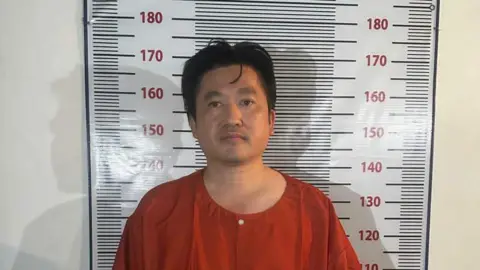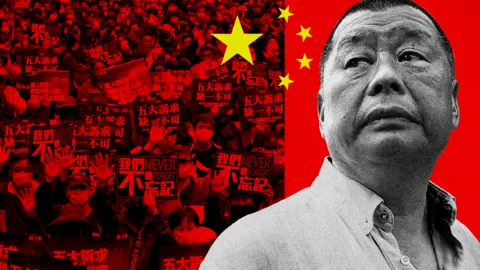
On a winter morning in 2022 Raphael Wong and Figo Chan walked into Hong Kong's Stanley prison to meet Jimmy Lai, the media billionaire who had been arrested two years before and was awaiting trial charged with national security offences.
They had all been part of the turbulent protests that had rocked Hong Kong in 2019, when hundreds of thousands took to the streets demanding democracy and more freedom in the Chinese territory.
They would also often meet for dinner, sometimes lavish meals, gossiping and bantering over dim sum, pizza or claypot rice.
In prison, he loved eating rice with pickled ginger, Chan said. No-one could have imagined Jimmy Lai would eat something like that!
But neither had they imagined a reunion at a maximum security prison, the protests crushed, friends and fellow activists jailed, Hong Kong just as boisterous and yet, changed. And gone was the owner of the irreverent nickname Fatty Lai: he had lost considerable weight.
Decades apart - Lai in his 70s, Wong and Chan about 40 years younger - they had still dreamed of a different Hong Kong. Lai was a key figure in the protests, wielding his most influential asset, the hugely popular newspaper, Apple Daily, in the hope of shaping Hong Kong into a liberal democracy.
That proved risky under a contentious national security law imposed in 2020 by China's Communist Party rulers in Beijing.
Lai always said he owed Hong Kong. Although he is a UK citizen, he refused to leave.
I got everything I have because of this place, he told the BBC hours before he was arrested in 2020. This is my redemption, he said, choking up.
He wanted the city to continue to have the freedom it had given him. That's what drove his politics - fiercely critical of the Communist Party and avowedly supportive of Hong Kong's pro-democracy movement. It cost him his own freedom.
Lai harboured a rabid hatred of the Chinese Communist Party and an obsession to change the Party's values to those of the Western world, the High Court ruled on Monday as it delivered the verdict in his trial.
It said that Lai had hoped the party would be ousted - or, at the very least, that its leader Xi Jinping would be removed.
Lai was found guilty on all counts of charges he had always denied. The most serious one - colluding with foreign forces - carries a maximum sentence of life in prison.
Never, Lai had said to that charge when he testified, arguing that he had only advocated for what he believed were Hong Kong's values: rule of law, freedom, pursuit of democracy, freedom of speech, freedom of religion, freedom of assembly.
Monday's verdict was welcomed by Hong Kong's chief executive John Lee, who said Lai had used his newspaper to wantonly create social conflicts and glorify violence.
Back in 2022, before Wong and Chan left the prison, Lai asked them to pray with him, to Wong's surprise.
Lai's Catholic faith had deepened in solitary confinement - an arrangement he had requested, according to authorities. He prayed six hours a day and he made drawings of Christ, which he sent in the mail to friends. Even though he was suffering, Wong said, he didn't complain nor was he afraid. He was at peace.
Peace was not what Jimmy Lai had pursued for much of his life - not when he fled China as a 12-year-old, not while he worked his way up the gruelling factory chain, not even after he became a famous Hong Kong tycoon, and certainly not as his media empire took on Beijing.
For Lai, Hong Kong was everything that China was not - deeply capitalist, a land of opportunity and limitless wealth, and free. In the city, which was still a British colony when he arrived in 1959, he found success - and then a voice.
Apple Daily became one of the top-selling papers almost instantly after its debut in 1995. Modeled on USA Today, it revolutionized the aesthetics and layout of newspapers, and kicked off a cut-throat price war.
From a guide to hiring prostitutes in the adult section to investigative reports, to columns by economists and novelists, it was a buffet targeting a full range of readers, said Francis Lee, a journalism professor at the Chinese University of Hong Kong.
Lai's journey is a testament to the courage and sacrifices made by those fighting for democracy in Hong Kong, illustrating the dangerous path of opposing a powerful authoritarian regime.