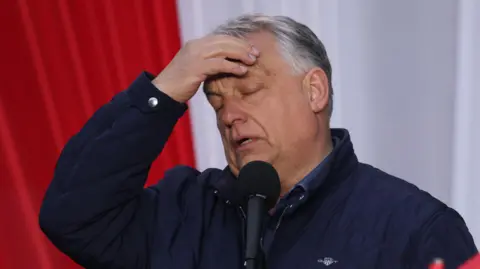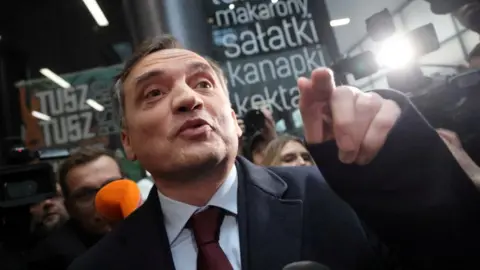
Hungary has granted political asylum to Poland's former Justice Minister Zbigniew Ziobro who is facing charges of embezzlement.
Ziobro is facing 26 charges related to embezzling money from a fund meant to be spent on crime victims and rehabilitating criminals.
Instead, he is accused of authorising the purchase of spyware that was allegedly used to hack political opponents' phones. He says he is a victim of political persecution.
Granting asylum to a citizen of a fellow EU member state goes against the spirit of EU standards.
But in the case of Hungary, it is neither new nor surprising. Ziobro is the second politician of the former Justice and Law-led government to be granted this status - last year it was his former deputy Michal Romanowski who fled to Budapest to seek protection.
Both are accused of corruption and misusing their power - most notably by using the money of the state-controlled Foundation for Justice which was under their oversight in order to fund their party and its cronies.
Ziobro was justice minister between 2015 and 2023 under the previous right-wing PiS-led government, which is politically aligned to Hungarian Prime Minister Viktor Orban.
If found guilty he could face up to 25 years in prison.
Writing on X, Ziobro stated, I have decided to accept the asylum granted to me by the government of Hungary due to the political persecution in Poland. He added, I have chosen to fight against political banditry and lawlessness. I stand in opposition to a creeping dictatorship, accusing Prime Minister Donald Tusk of waging a vendetta against him.
Ziobro is accused of authorising a 25m zloty ($7m; £5.15m) purchase of Israeli-made Pegasus spyware, which Poland's current coalition government and a European Parliament investigative team found was used to secretly hack the phones of political opponents.
Current Foreign Minister Radoslaw Sikorski said his phone was hacked, and Tusk stated that his wife's and daughter's phones were also hacked.
Ziobro is also accused of awarding Justice Fund grants to fire stations and women's associations without proper competition to bolster support for the government.
As minister of justice from 2015 to 2023, Ziobro was the author of judiciary reforms which provoked a major conflict with Brussels. The issue led to a freeze of EU funds for Poland and to verdicts from the European Court of Justice, which deemed them as violating fundamental EU rules.
Zbigniew Ziobro is thus for Orban not just a representative of an allied party, but a brother-in-arms in defense of national sovereignty against alleged EU oppression. Orban aims to portray himself as the leader of the patriotic movement in Europe, making Ziobro's asylum a convenient development for advancing this agenda.