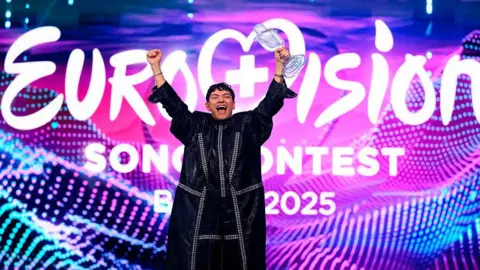
Known for its glitzy stage costumes and sometimes outlandish performances, the Eurovision Song Contest is now launching its first ever Asia edition.
Broadcasters from 10 countries in the region, including South Korea, Bhutan, Thailand and the Philippines have confirmed that they will be taking part. According to the contest's website, which lists the participating countries, there are more to follow.
Countries will first host their own national selections before the grand final in Bangkok, to be broadcast live on 14 November.
First held in 1956, Eurovision has grown into the world's longest running international music competition.
As we mark the 70th anniversary of the Eurovision Song Contest, it feels especially meaningful to open this next chapter with Asia, a region rich in culture, creativity and talent, said Martin Green, director of the Eurovision Song Contest at the EBU.
As a rule, the songs performed at Eurovision must be original and lead vocals sung live. Performers are then voted on by music experts and fans.
The competition has supercharged the careers of some of the world's most famous acts, such as Swedish pop group Abba and Canadian singer Celine Dion, who represented Switzerland in 1988.
Around 163 million people tuned in to last year's contest, which offered songs ranging from ebullient bangers to soulful ballads.
However, the contest has also become a site of international political tensions. A number of countries are boycotting the contest this year, set to take place in Vienna in May, over Israel's participation. Russia has been banned from entering since 2022, following its invasion of Ukraine.
Since the 2000s, there have been multiple attempts to create an Asian version of the iconic contest, but none of those previous efforts bore fruit.
Chuwit Sirivajjakul, a senior official at the Thailand Tourism Authority, strongly believes that Bangkok is the ideal host city for Eurovision Asia, citing its cultural richness and celebratory spirit.
This Asia edition of the contest is being organized by the European Broadcasting Union alongside the Los Angeles-based entertainment company Voxovation and Thailand-based S2O Productions.