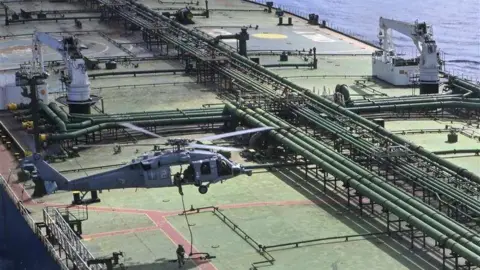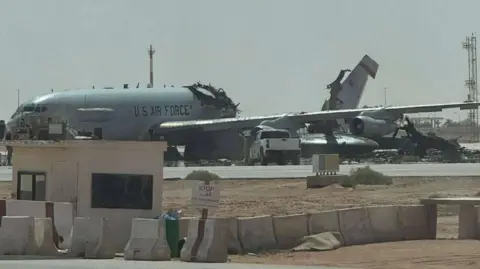
Recent verified images have surfaced showing a US command and control aircraft, specifically the E-3 Sentry, destroyed at an air base in Saudi Arabia. The visuals were originally shared by a Facebook page dedicated to US military news.
The photos depict the E-3 Sentry appearing to be split in two, raising alarms about the extent of the damage. Confirmation has come that these images were taken at the Prince Sultan air base, located approximately 100 km southeast of Riyadh, as corroborated by matching features visible in satellite imagery.
Currently, US Central Command has not released any public statements regarding the incident, despite inquiries from multiple news outlets.
On Friday, a US official informed Reuters that twelve American personnel had been injured, with at least two suffering serious wounds due to an Iranian military assault on the air base. Reports indicate that not only was the E-3 Sentry damaged, but at least two US refueling aircraft also faced significant damage.
Iran's IRGC-affiliated news agency, Fars, claims that a Shahed drone was responsible for the strike on the E-3 aircraft.
Additional analysis by BBC Verify noted satellite imagery from March 11 that showed an E-3 present at the air base. However, it remains unclear if it is the same aircraft depicted in the recent photos.
One of the verified images reveals the aircraft's tail number, which was traced using a flight-tracking site, indicating it was airborne near the base on March 18.
Satellite images captured on the same day of the incident seem to show a fire on the airbase apron, but it is uncertain if this fire was related to the attack that led to the E-3's damage.
The E-3 Awacs, which stands for Airborne Warning and Control System, is based on the Boeing 707 airliner and is equipped with a distinct rotating radar dome. This radar enables it to track and identify potential targets over long distances, providing essential early warnings during combat operations. The aircraft plays a critical role in helping commanders maintain control during air battles.
First entering service in 1977, the E-3 is projected to remain active with the USAF until 2035.