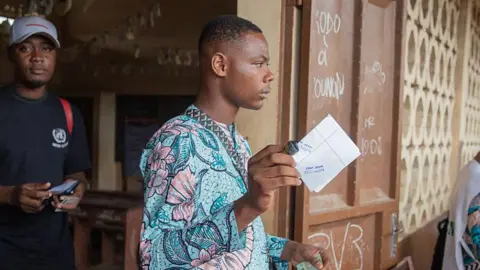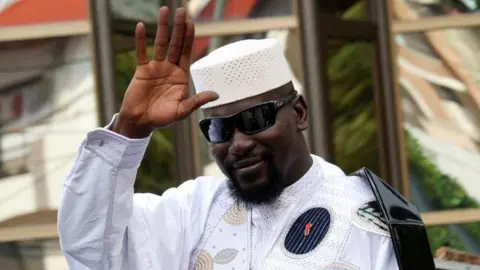
Guinea's junta leader Gen Mamady Doumbouya has taken a huge lead in a presidential election his main challengers were barred from contesting, initial results show.
Gen Doumbouya is hoping to legitimise his rule after seizing power in a coup four years ago.
A civil society group campaigning for the return of civilian rule condemned the election as a 'charade', while opposition candidates said the poll was marred by irregularities.
On Monday, internet monitoring organisation NetBlocks reported that access to social media platforms TikTok, YouTube, and Facebook had been restricted as Guineans waited for the full results.
There has been no official comment on the restrictions, but opponents see it as an attempt by the junta to stifle criticism of the results.
Gen Doumbouya, 41, won more than 80% of the vote in numerous districts in capital city Conakry, according to official partial results read out on television.
Gen Doumbouya had a big lead in several other areas as well, including Boffa and Fria in the west, Gaoual in the north-west, northern Koundara, Labe, and Nzerekore in the south-east.
After overthrowing then-83-year-old President Alpha Condé in 2021, he promised not to seek election and to hand power to a civilian.
Neither I nor any member of this transition will be a candidate for anything... As soldiers, we value our word very much, he said at the time.
However, Doumbouya has broken this promise by running for office after a new constitution allowed him to do so.
Eight other candidates took part in Sunday's election, but the exclusion of main opposition parties RPG Arc en Ciel and UFDG left none of the participants with a solid political footing.
Although he is popular with many of Guinea's youth, Gen Doumbouya has faced criticism for restricting opposition activities, banning protests, and stifling press freedom leading up to the elections.
The general justified deposing Condé by citing rampant corruption, disregard for human rights, and economic mismanagement.
Guinea, which hosts the world's largest bauxite reserves and some of its richest iron ore, struggles with poverty, as over half of its population lives below the poverty line according to World Bank figures.