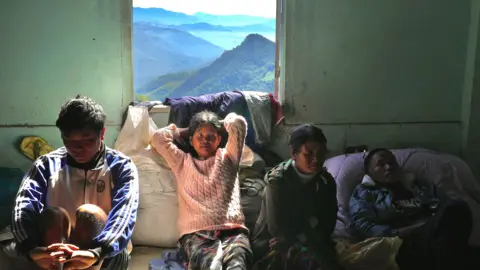
Late one night last month, Iang Za Kim heard explosions in a neighbouring village, then fighter jets flying overhead. Terrified, she fled her home in K-Haimual, Chin State, with a few belongings as Myanmar's military launched a fierce campaign of air strikes against rebel-held areas, prompting thousands to flee.
Women like Iang express their fears not only of the immediate danger but of being forced to participate in elections scheduled for December 28, which they regard as a sham aimed at legitimizing the junta's rule.
From news reports, the current offensive is being described as one of the most brutal in recent years, with civilians recounting their traumatic experiences as they seek safety in places like Mizoram, India, amidst ongoing attacks that have targeted schools and hospitals.
The junta's strategy has generated outrage, especially from displaced civilians who have witnessed atrocities, including airstrikes that have led to loss of life among children and community members.
Bawi Nei Lian is among the latter—a former resident of Falam town—who has endured the anguish of losing his home twice due to military actions. He and others emphasize their distrust in the electoral process, given the absence of the National League for Democracy party and other opposition forces.
The elections are set to unfold over several phases, but many fear widespread vote rigging that would ensure the military's grip on power.
In a mountainous region, pediatric care facilities cater to injured fighters, highlighting the severe human cost of this conflict as young adults continue to join the resistance against the military government.
Meanwhile, elderly civilians express a mix of hope and sorrow, longing for a return to democracy but fearing they may not live to see the day.