In brief
Ukrainian officials announced that a ceasefire, originally aimed at delivering food and medical aid to the besieged city of Oleshky, has been extended to the entire Kherson region. The agreement was brokered with help from US First Lady Melania Trump and Pope Leo XIV, and Moscow has pledged to halt shelling in both the occupied and Ukrainian‑controlled zones. The truce includes a plan for clearing mine‑ridden roads and evacuating residents, with the first wave of ambulances and aid trucks scheduled for Thursday. While both sides report adherence to the truce, humanitarian experts warn that communication gaps and a heightened risk of reprisals could hamper the safe passage of supplies and civilians. The truce is seen by Ukraine as a potential stepping stone for broader peace negotiations.”
A ceasefire that began as a humanitarian lifeline for the besieged city of Oleshky has now been broadened to cover the entire Kherson region, according to Ukrainian officials. The agreement was brokered with aid from US First Lady Melania Trump and Pope Leo XIV, and both Russian forces and Ukrainian defenders claim the truce is being respected.
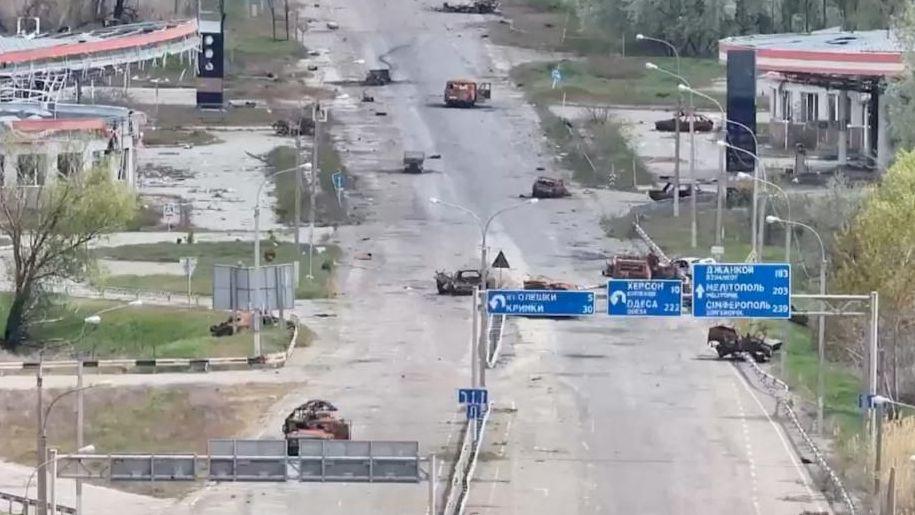
For months, residents of Oleshky—once home to nearly 24,000 people—have endured a brutal siege. Russia has cut off all electricity, gas and water, while mines and drones have turned the main access roads into death traps. The city’s only link to the outside world runs across the treacherous Dnipro river, which has also been mined and partially destroyed, leaving civilians trapped on both the occupied and Ukrainian‑controlled banks.
The ceasefire now covers a corridor several kilometres wide along the river, allowing a fleet of humanitarian trucks to enter the city on Thursday and a coordinated evacuation to begin on Friday. Russian defence officials say their army’s Dnepr engineering group is clearing main roads of mines and “booby‑trap” devices, while Ukrainian authorities work to register residents who wish to leave.
Key figures on both sides are hopeful the agreement could catalyse a larger peace settlement.
- Melania Trump’s public appeal to President Putin was echoed by Ukrainian Foreign Minister Andrii Shtybak, who said a successful truce could pave the way for “more steps in the peace process.”
- Kremlin spokesman Dmitry Peskov praised the “planned” ceasefire and credited the US mediation team.
- Deputy head of Kherson, Oleksandr Tolokonnikov, confirmed that Russian shelling had stopped throughout the region, including the Ukrainian‑held city of Kherson.
- Ukraine’s General Staff cautions civilians not to share unverified evacuation routes to avoid Russian reprisals.
- Estimated 1,700–2,000 people remain in Oleshky; additional thousands are located in surrounding villages.
While the truce has been formally extended until 22:59 local time on Sunday, the practical challenges remain. Communication in occupied territory is patchy, and many residents fear that returning to Ukrainian control could be impossible if Russian forces confiscate phones or punish those who show Ukrainian support. Evacuees must also navigate an irreversible scar: the Dnipro’s bridges are destroyed, and the riverbank is still heavily mined.
On the ground, hope and uncertainty are in tension. One resident, Serhii, finally escaped Oleshky nearly a month ago by trekking through minefields. He is now in the Russian‑controlled part of Kherson but is wary of the uncertainty of returning home, insisting that “you simply cannot trust the Russian Federation.”
With the ceasefire intact, international observers are monitoring Moscow’s compliance closely. If holds, it could set a precedent for other break‑away regions and shrink the front line—though peace experts warn that the wider conflict is far from over. Nonetheless, for the people of Oleshky and the wider Kherson region, the expanded truce is an essential, albeit fragile, lifeline in a war that has left millions displaced and thousands dead.”