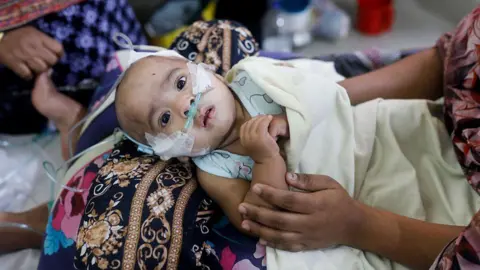
Bangladesh has launched an emergency vaccination campaign after a fast-spreading measles outbreak is suspected of killing more than 100 people, mostly children, in what may be the country's most lethal wave of the disease in recent history.
The campaign, which began on Sunday, comes amid more than 7,500 suspected measles cases since 15 March, according to health ministry data.
More than 900 of these cases have been confirmed - a sharp increase from 2025, when just 125 measles cases were recorded over the entire year, local media report.
While Bangladesh has long vaccinated children against the highly contagious disease, the recent outbreak has exposed gaps in its program, raising concern.
Vaccines are foundational to child survival, Rana Flowers, the Unicef representative in Bangladesh, said in a statement on Sunday, adding that the current measles outbreak was putting thousands of children, especially the youngest and most vulnerable, at serious risk.
Why is there a spike in measles in Bangladesh?
In Bangladesh, a nation of 170 million people, routine measles vaccines are given to children as young as nine months old. However, Shahriar Sajjad, deputy director of the Health Department, noted that about one-third of those infected in the recent outbreak were under nine months old.
The infections of these young infants, who are not yet eligible for routine vaccination, are especially alarming, said Flowers from Unicef. Along with routine vaccinations, Bangladesh conducts special measles vaccination campaigns every four years.
But these campaigns haven't gone according to plan. There have been no special measles vaccination campaigns since 2020, first due to Covid and then because of the political situation, Sajjad told BBC Bangla.
Bangladesh experienced political upheaval in 2024, when massive anti-government protests toppled its long-ruling leader Sheikh Hasina. An interim government took over after Hasina's ousting, and only in February this year did the country elect a new government.
A measles vaccination campaign was supposed to be held in April this year, but it did not happen, Sajjad said. A health official also mentioned that procurement issues had led to a shortage of vaccines, including for measles.
Many in Bangladesh have blamed the vaccine shortages on the former interim government, which oversaw a new vaccine procurement system. However, Unicef stated that measles resurgences are typically the result of these accumulated gaps rather than a single factor.
What is Bangladesh doing about it?
Along with international partners like Unicef and the World Health Organization (WHO), Bangladesh has launched an emergency vaccination campaign for measles and rubella, targeting more than 1.2 million children between six months and five years old.
This campaign will be rolled out across 30 upazilas and focus on children who have missed routine immunization. There will also be a particular emphasis on Dhaka and Cox's Bazar, home to crowded Rohingya refugee camps.
Besides the vaccination drive, health authorities are also publishing infographics that teach people how to identify and prevent measles.
What is measles?
Measles is a highly contagious airborne disease that can lead to severe complications and death. Common symptoms include high fever, sore, red and watery eyes, coughing, and sneezing. In 2024, an estimated 95,000 people were killed by measles around the world - most of them children under five years old.
Measles can be prevented through vaccination - but according to the WHO, 95% of the population must be vaccinated to stop the disease from spreading. Over the past two decades, the number of global measles cases and deaths has fallen sharply, with the recent rise attributed to falling vaccination rates.