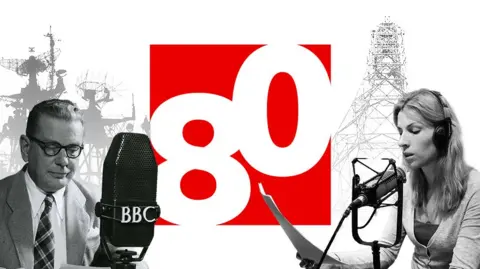
The Kremlin is tightening its grip over what Russians can do and see online, making it harder for outlets like the BBC to reach their audiences. For the past 80 years BBC Russian has sought to bypass those restrictions, which for decades featured jamming of its short-wave radio broadcasts and now involve blocking its website. The latest restrictions in Russia have included widespread mobile internet outages and a reported plan to block the Telegram news and messaging app.
On 24 March 1946, the BBC started its first regular radio broadcast in the Russian language aiming at giving listeners behind the Iron Curtain in the Soviet Union an alternative to state propaganda and a tightly controlled cultural scene. By 1949, jamming of the signal was already the norm. For almost half the 20th Century, Soviet people had to jump through hoops to listen to foreign broadcasts, and for some it was truly a sport, remembers Natalia Rubinstein, an ex-BBC presenter and former resident of Leningrad, or modern-day St Petersburg.
We really wanted to know what was being hidden from us, she says. Rubinstein recalls how people who were fond of cross-country skiing took their radios with them out of town, where there were fewer jammers. I still have this picture before my eyes: a person leaning on a tree, with ski poles next to him, listening to the radio somehow nestled on their chest.
The jamming of foreign broadcasts was pioneered by Nazi Germany during World War Two, using noise or signals from more powerful transmitters located closer to the listeners. During the Cold War, the BBC would repeat its 90-minute Russian-language bulletin three times a week, so people could listen at least once. It was not all news; Soviets could tune in to Western rock music, hear extracts from banned literature, and even, for a brief time, participate in quizzes.
According to a CIA memo from 1960, stories about life in Britain or the US went on air without interference, but discussions of global conflicts or reports on the economic and political life in the Socialist bloc were always jammed. Occasionally BBC Russian succeeded in outfoxing the jammers. Peter Udell, who managed the BBC's East European service, shared that during Soviet leader Leonid Brezhnev's death in 1982, a special program on Brezhnev snuck through clear because the jammers had assumed they were off shift.
By 1987, under Mikhail Gorbachev's liberal reforms, the BBC Russian team finally began receiving feedback from listeners who had been kept in the dark for decades. In the final week of February 2022, as Russia launched its full-scale invasion of Ukraine, BBC Russian's audience exceeded 10 million, showcasing a remarkable appeal amidst the tumult of censorship. However, on 4 March 2022, the BBC's website was blocked in Russia, accused of spreading false information of public interest. Amidst the persecution of independent media, BBC Russian continues to operate from abroad, facing significant personal risks for its journalism.
Despite hindrances like widespread internet outages and the State's increasing control over technology, BBC Russian remains steadfast, with current audience figures reflecting the ongoing demand for independent journalism in Russia. The future of free expression remains uncertain, yet BBC Russian's resiliency persists as a symbol of hope and defiance.
On 24 March 1946, the BBC started its first regular radio broadcast in the Russian language aiming at giving listeners behind the Iron Curtain in the Soviet Union an alternative to state propaganda and a tightly controlled cultural scene. By 1949, jamming of the signal was already the norm. For almost half the 20th Century, Soviet people had to jump through hoops to listen to foreign broadcasts, and for some it was truly a sport, remembers Natalia Rubinstein, an ex-BBC presenter and former resident of Leningrad, or modern-day St Petersburg.
We really wanted to know what was being hidden from us, she says. Rubinstein recalls how people who were fond of cross-country skiing took their radios with them out of town, where there were fewer jammers. I still have this picture before my eyes: a person leaning on a tree, with ski poles next to him, listening to the radio somehow nestled on their chest.
The jamming of foreign broadcasts was pioneered by Nazi Germany during World War Two, using noise or signals from more powerful transmitters located closer to the listeners. During the Cold War, the BBC would repeat its 90-minute Russian-language bulletin three times a week, so people could listen at least once. It was not all news; Soviets could tune in to Western rock music, hear extracts from banned literature, and even, for a brief time, participate in quizzes.
According to a CIA memo from 1960, stories about life in Britain or the US went on air without interference, but discussions of global conflicts or reports on the economic and political life in the Socialist bloc were always jammed. Occasionally BBC Russian succeeded in outfoxing the jammers. Peter Udell, who managed the BBC's East European service, shared that during Soviet leader Leonid Brezhnev's death in 1982, a special program on Brezhnev snuck through clear because the jammers had assumed they were off shift.
By 1987, under Mikhail Gorbachev's liberal reforms, the BBC Russian team finally began receiving feedback from listeners who had been kept in the dark for decades. In the final week of February 2022, as Russia launched its full-scale invasion of Ukraine, BBC Russian's audience exceeded 10 million, showcasing a remarkable appeal amidst the tumult of censorship. However, on 4 March 2022, the BBC's website was blocked in Russia, accused of spreading false information of public interest. Amidst the persecution of independent media, BBC Russian continues to operate from abroad, facing significant personal risks for its journalism.
Despite hindrances like widespread internet outages and the State's increasing control over technology, BBC Russian remains steadfast, with current audience figures reflecting the ongoing demand for independent journalism in Russia. The future of free expression remains uncertain, yet BBC Russian's resiliency persists as a symbol of hope and defiance.